

As an Amazon Associate I earn from qualifying purchases. This page contains affiliate links; we may earn a commission if you buy through them.
Guatemalan coffee is known for chocolate, cocoa, and bright acidity from volcanic highlands like Antigua. Amazon bags on this page include Volcanica Guatemala Antigua.
Despite its relatively small size compared to other Central and South American countries, Guatemala is extremely diverse in numerous ways.
For instance, Guatemala has one of the most diverse climates not only in Central America or even the whole Americas but in the whole world! But there’s more – Guatemala houses 21 Mayan dialects, an interestingly diverse language despite its small size. And of course, Guatemala is also home to a wide variety of coffee flavor profiles and blends.
However, Guatemala, as with most countries, did not always have it easy. They faced a lot of harsh difficulties, from political upheaval to the economic disruption that came from foreign governments. Nevertheless, this small Central American nation has a lot of things to be proud of, and certainly, their coffee is one of those things!
In this article, we will discuss the things you need to know about Guatemalan coffee – its characteristics and qualities, growing facts, and its history. Nicaraguan coffee growing regions are known for their unique climate and rich volcanic soils. These factors contribute to the distinctive flavor profiles found in coffees produced here. Additionally, the dedication of local farmers to sustainable practices enhances the quality of the beans. The origin of Mexican coffee beans is steeped in rich traditions and cultural practices. Known for their smooth and bold flavors, these beans have gained popularity in the specialty coffee market. Many regions in Mexico, such as Chiapas and Veracruz, provide the ideal conditions for coffee cultivation, contributing to the overall quality of the coffee produced.
Guatemalan Coffee’s Characteristics and Qualities

Perhaps, unlike other coffees, what really makes Guatemalan coffee so fascinating and remarkable is its diversity of flavor profile. Not only does Guatemalan coffee have a wide variety of flavor profile diversity, but the different flavors grown from various regions of the country are clearly distinguished from one another. This is not so common in other countries where their coffee’s flavor differences are not clearly distinguishable, even though each has its dominant flavor profile.
The different tastes vary due to the coffee region where it grows. Guatemala has four major coffee-growing regions: Antigua, Atitlan, Coban, and Huehuetenango. Some of the different flavor profiles that arise from Guatemalan coffee beans include the following:
- Antigua – Antigua is Guatemala’s southern highlands region. The region of Antigua is filled with active volcanoes. This produces a distinguishable apple-like acidity, deep chocolate flavors, and sweet floral notes.
- Atitlan – Coffee beans that grow around Lake Atitlan and its nearby volcanoes tend to have a complex spice note, pleasant acidity, full-body, and rich floral aroma.
- Coban – This Guatemalan subtropical rainforest produces coffee beans that tend to have a medium body, mild acidity, and sweet fruity flavor profiles.
- Huehuetenango – This northern highlands region of Guatemala has a unique microclimate, making it capable of producing coffee that has interesting characteristics of winey acidity and sweet, rich flavor profiles.
In Guatemala, most of its coffee farms are located at elevations as high as more than 5,000 feet, which is one of the major reasons why Guatemalan coffee tends to have a bright acidity. Add the fact that Guatemala’s coffee regions tend to be rich with volcanic soil due to active volcanoes – the volcanic soil gives Guatemala’s coffee beans with high amounts of nutrients; this is one of the reasons why Guatemalan coffee beans have such exceptional flavors.
Guatemalan Coffee’s Growing Facts

Most of the coffee plants that are planted in Guatemala’s coffee region come from the Bourbon and Typica coffee variety. Though Guatemala also has some geisha farms, most of them are located on the slopes of Volcan Acatenango which is near Antigua.
One of the reasons why Guatemala has such successful coffee production is because, for the most part, Guatemala has a well-functioning and well-communicating network of coffee producers. This is actually surprising, considering that Guatemala generally lacks infrastructure – for instance, there is no national post office. Despite the lack of infrastructure, coffee farmers and producers still manage to stay well-connected to one another. This connection and communication happen through the efforts of Anacafé (Asociación Nacional del Café), the trade organization that promotes and champions coffee growers.
One of the major projects of Anacafé’s was to create and brand eight coffee-growing regions under the motto “A Rainbow of Choices.” These coffee-growing regions are Antigua Coffee, Highland Huehue, Rainforest Coban, Acatenango Valley, Traditional Atitlan, New Oriente, Volcanic San Marcos, and Fraijanes Plateau.
Coffees that are grown in these regions are all delicious and very distinct to one another, hence, exploring and experimenting with them can be very exciting. Be sure to try them out! Coffee flavor profiles by region can offer a unique tasting experience that reflects the local climate and soil conditions. Different regions produce beans with varying notes, ranging from fruity and floral to earthy and spicy. By savoring coffees from various parts of the world, you can embark on a flavorful journey without leaving your home.
A Little History of Guatemalan Coffee
Planting and producing in Guatemala first arrived during the late 1700s. However, due to poor economic conditions, Guatemalan locals at the time were unable to properly invest and plant their own coffee beans. However, in the 1860s, coffee became an economically important crop in the country. This came following the replacement of its previously most profitable agricultural product, indigo, which had lost its demand in the market due to artificial dyes.
The 1860s are just the beginning of the rise of the coffee industry in Guatemala. Around the year 1870, the dictator Justo Rufino seized much of Guatemala’s public lands and decided to reserve them for coffee farming. This gave coffee farming in Guatemala a huge boost. After three decades, in 1900, this effort became fruitful. In this year, Guatemala was able to produce and export over 300 million pounds of coffee, making up around 80% of its export!
Modern History of Guatemalan and Guatemalan Coffee

Despite booming, at least in their coffee sector, Guatemala would face the Great Depression of the late 20s and 30s. This had significant impacts and effects on Guatemala. Both on its coffee industry and in Guatemalan politics and economics in general.
The Great Depression led Guatemala to face another dictatorship. Starting in 1940, the country moved to elect its leaders using a democratic system. In 1940, Guatemala democratically elected President Jacobo Arbenz, but his rule and leadership will not last long. In a few short years, the United States, to protect their own economic interests, interfered with Guatemalan politics through a CIA-led coup, which overthrew President Jacobo, being replaced by another dictatorship in 1954. This meddling from foreign governments caused a woeful range of civil wars that happened between the 60s and 90s.
So, what do these economic and political problems have to do with Guatemalan coffee? Guatemala’s coffee, among other industries, faced damage from Guatemala’s turbulent policies and social chaos that came from the civil wars. The political and economic “roller coaster” sent Guatemala’s coffee industry into its own “roller coaster” as well.
Turmoil and political and economic instability
During these years of turmoil and political and economic instability, many coffee farmers and growers were forced to leave coffee farming. They left in hopes for a more promising income source and better future. In fact, many of these same farmers even left their country in hopes to find a better future.
But not all farmers were lucky enough. Many coffee farmers and growers were killed during the times due to the civil wars. This was either because they actively participated or sometimes, they are just collateral damage of these civil wars. Aside from tragic deaths, the economy halted, further pausing the growth of Guatemala’s coffee industry and its economy in general.
Thankfully, the civil unrest and political and economic instability would come to a stop. After decades of civil wars, among other social troubles, Guatemala can finally rebuild itself. Just as the whole Guatemalan economy is reviving, so is their coffee industry. Local coffee farmers and growers can go back to coffee farming and begin to thrive in their industry once again.
Currently, Guatemala is the 10th largest producer of coffee in the whole world. When it comes to specialty-grade coffee produced in their continent, Guatemala is only second to Colombia.
The coffee industry still feels its dark, troubled past, but it nevertheless strives to go back and rebuild itself up. Today, the Guatemalan coffee industry continues to grow.
Try It Out — Mocha Guatemalan Coffee

This recipe is perfect either iced or hot. If you are craving a warm, steamy cup in the morning, go for it. But if you are looking for more of a refreshing iced beverage, try it over ice. If you want to check out more of our delicious recipes you can find “10 Easy and Delicious Recipes” HERE.
Ingredients →
- 1 tablespoon cocoa powder
- double shot of espresso
- 1/2 cup of milk
- Whipped cream
How to make it →
- Pull a double shot of espresso, then top of with milk of choice.
- Mix in the cocoa powder and top with whipped cream.
- Serve and enjoy!
Our Guatemalan Coffee Picks
We matched one coffee to each mood and moment below. Tap the image or the coffee name to see it on Amazon. We chose these from each roaster’s published details rather than from brewing them ourselves yet, so both are labeled research-rated. As an Amazon Associate we earn from qualifying purchases.
Feeling fresh and clear-headed: a bright morning cup
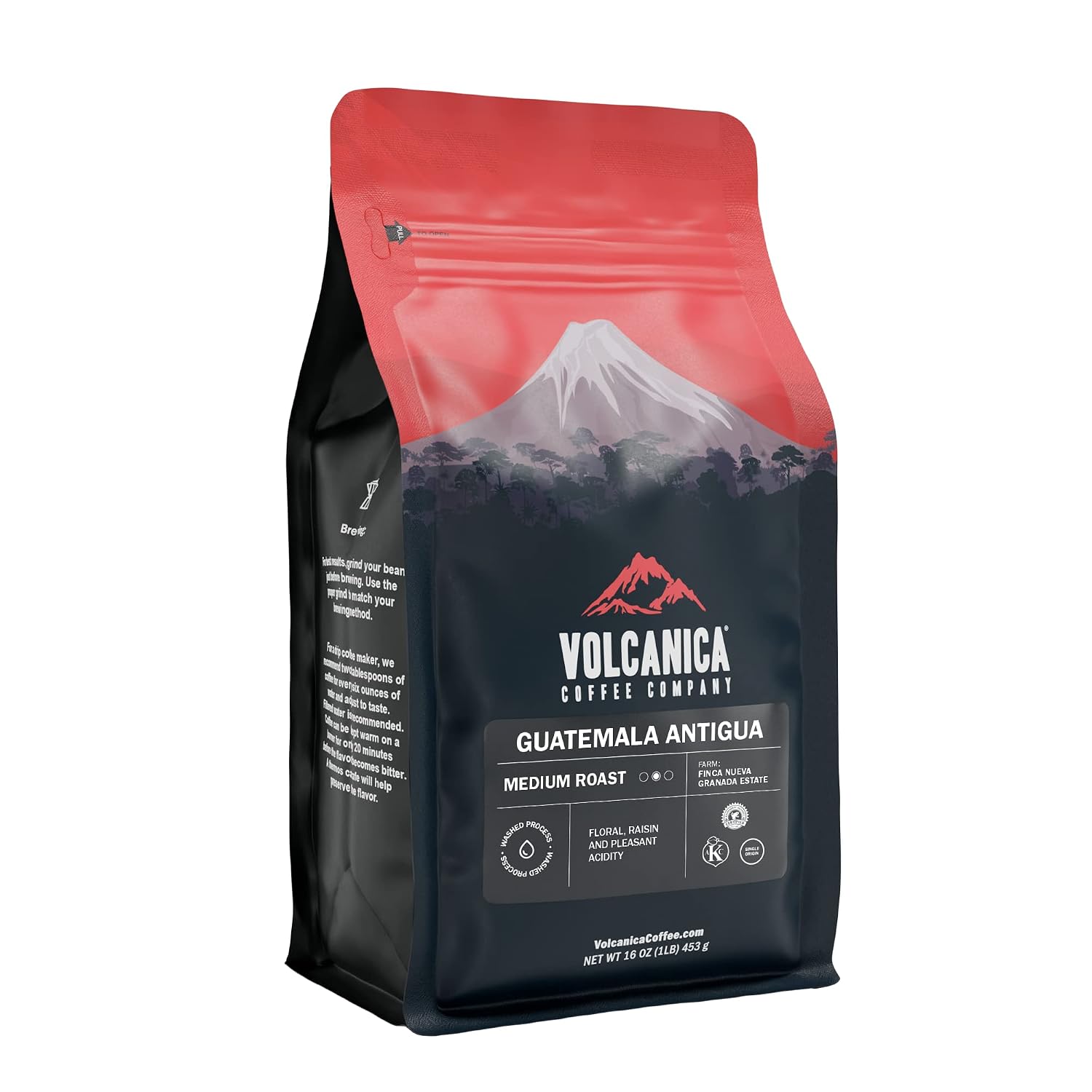
Our pick: Volcanica Guatemala Antigua, medium roast, USDA Organic, whole bean, 16 oz.
Why we recommend it: For a morning when you want a cup that feels clean and uplifting, this Antigua fits. Volcanica sources it from the Finca Nueva Granada Estate and lists it as USDA Organic, washed and sun-dried, with notes of honey, apple, tea, and floral brown sugar. This article describes Antigua as a volcanic highland region known for apple-like acidity, deep chocolate flavors, and sweet floral notes, and this bag’s profile follows that description closely.
How we reached this: We checked Volcanica’s published estate, processing, roast, and tasting notes against this article’s description of the Antigua region, using the criteria in our coffee rating system. Research-rated, not yet brewed by our team.
Feeling indulgent: a mocha with a double shot
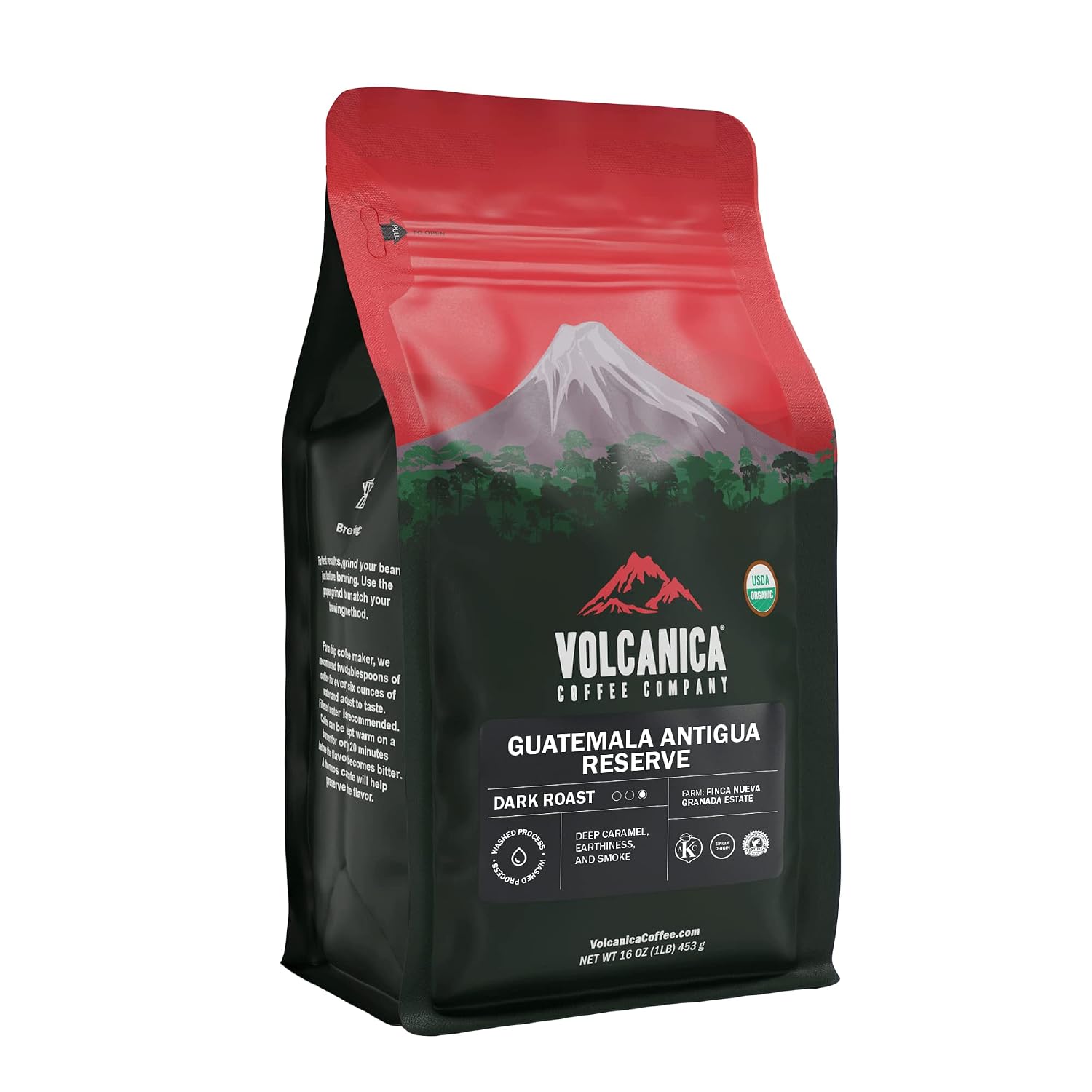
Our pick: Volcanica Guatemala Antigua Reserve, dark roast, whole bean, 16 oz.
Why we recommend it: When you want coffee to double as dessert, this dark Antigua gives a mocha real depth. Volcanica sources it from the Santa Barbara Estate, set between volcanoes in Antigua, and lists deep caramel, earthy, and smoky notes with a heavy body and a sweet finish. This article’s mocha recipe pulls a double shot of espresso and stirs in cocoa powder, and a heavy-bodied dark roast stands up to the chocolate and milk.
How we reached this: We checked Volcanica’s published estate, roast, body, and flavor notes against this article’s Guatemalan mocha recipe, using the criteria in our coffee rating system. Research-rated, not yet brewed by our team.