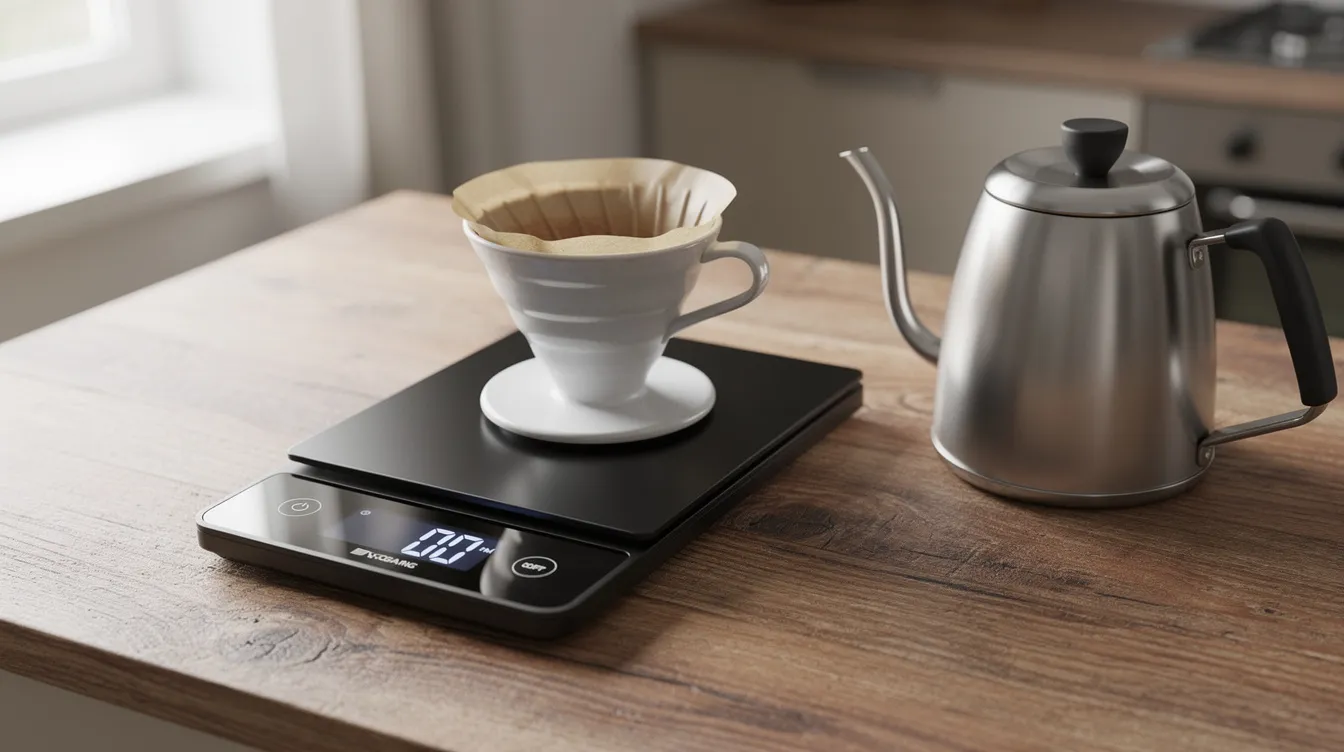
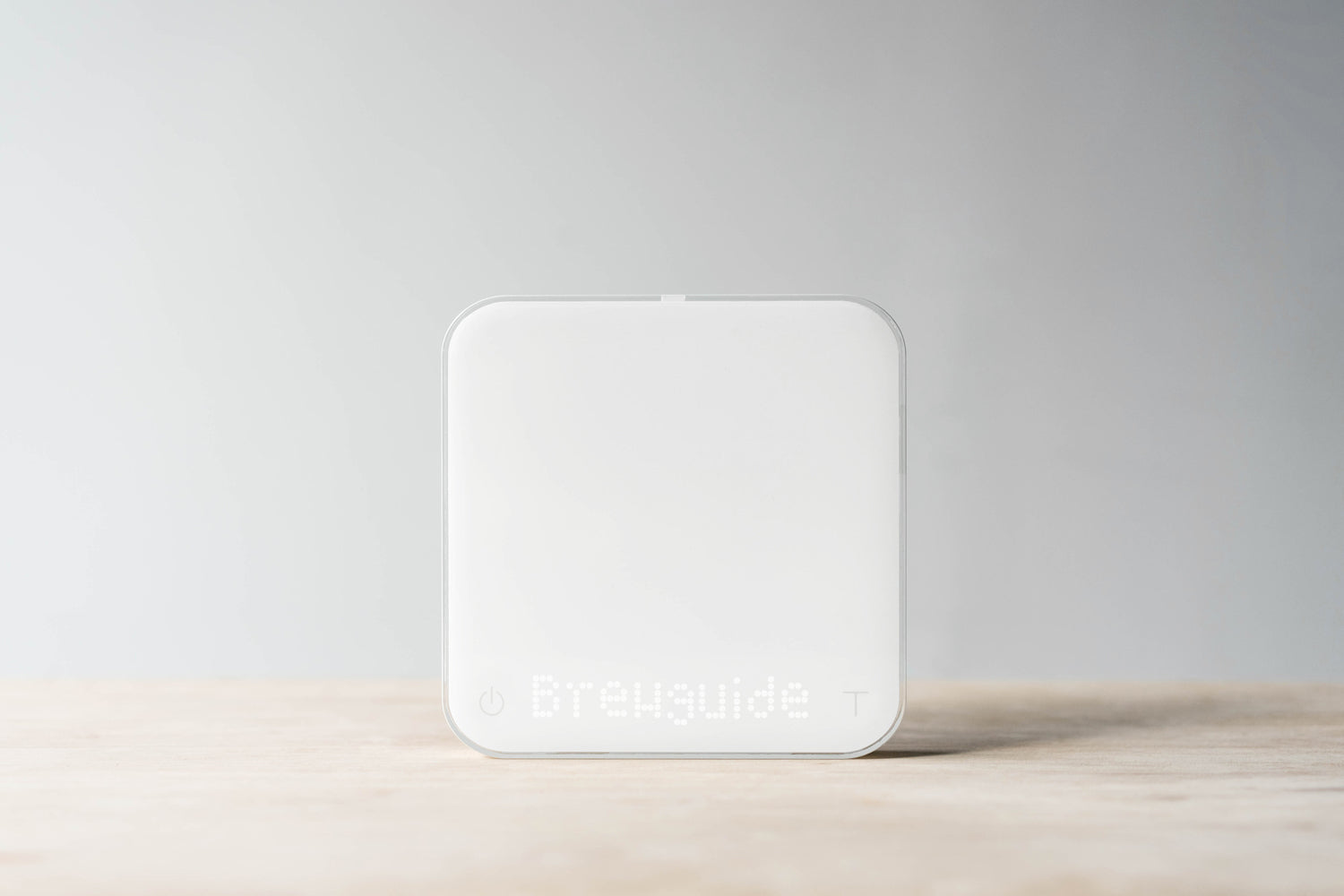
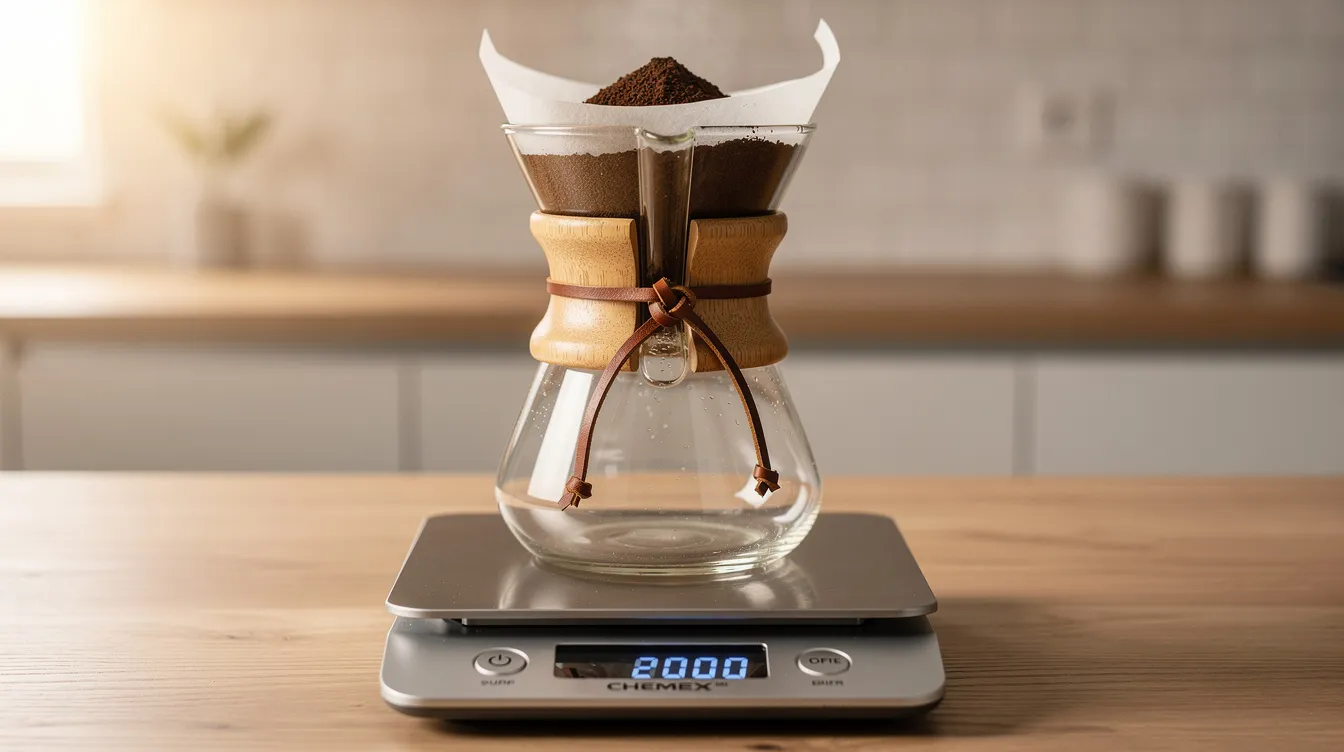
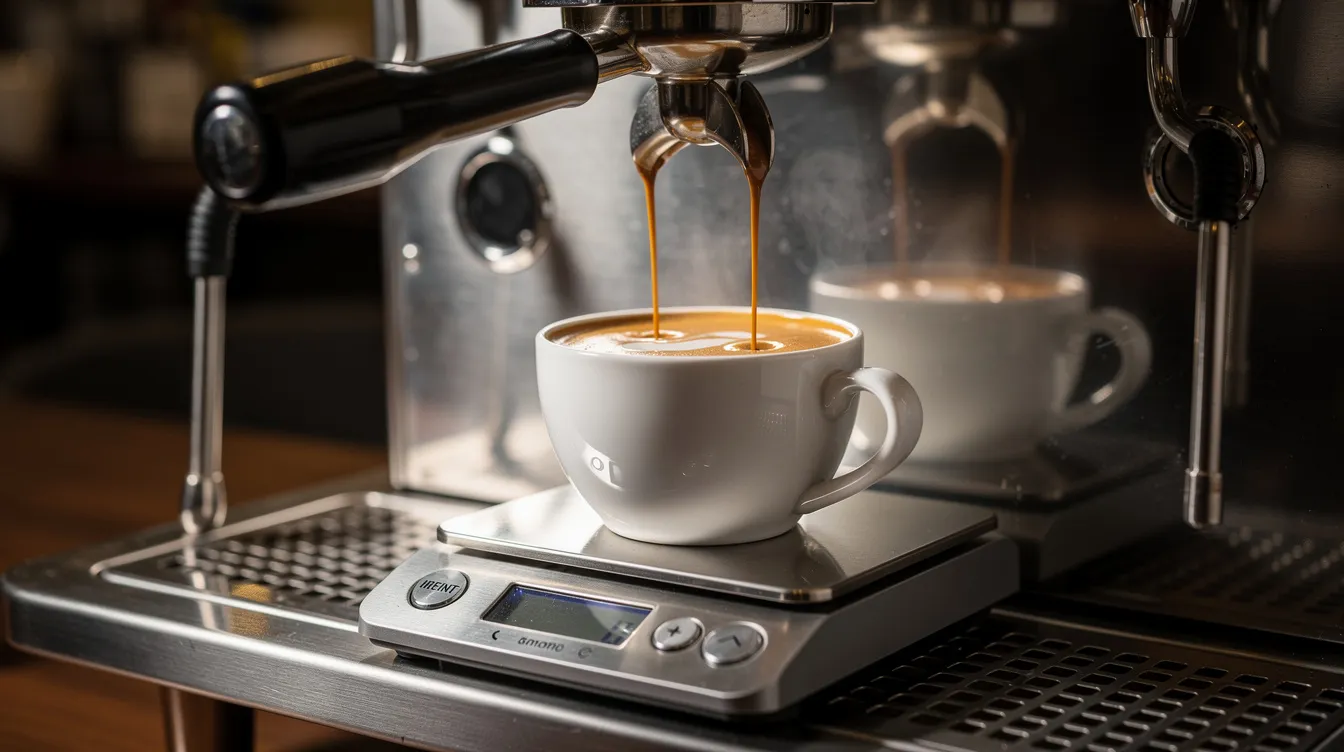
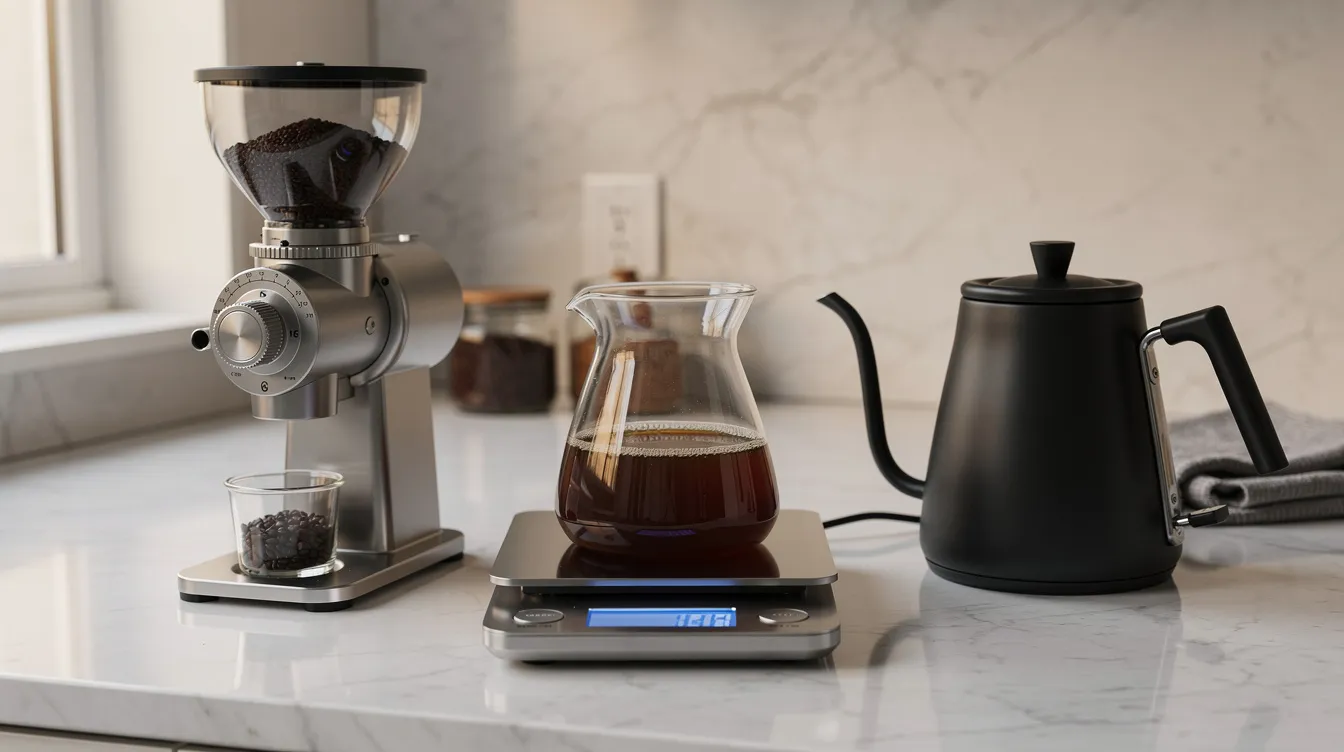
A reliable coffee scale is the single most impactful upgrade you can make to your home brewing setup. Whether you’re pulling espresso shots or dialing in a pour-over recipe, weighing coffee with 0.1 g precision removes guesswork and keeps your cups consistent day after day.
This guide breaks down the top coffee scales available in the U.S. in 2026, explains the features that actually matter, and helps you choose the right one for your brewing style and budget.
Best best overall pick
For this roundup, Timemore Black Mirror Basic 2.0 is the best overall we recommend first—the same pick at the top of our At-a-glance cards below.
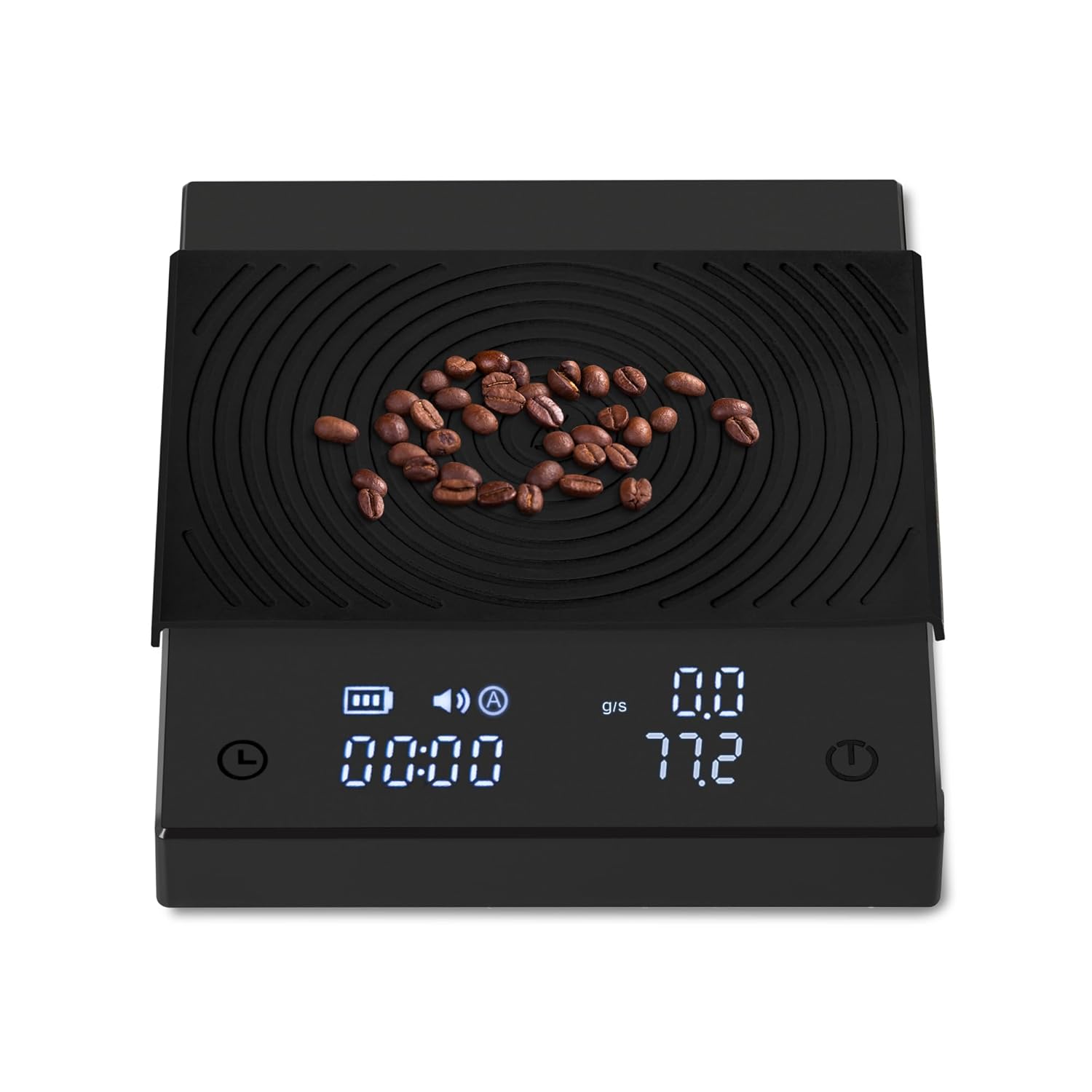
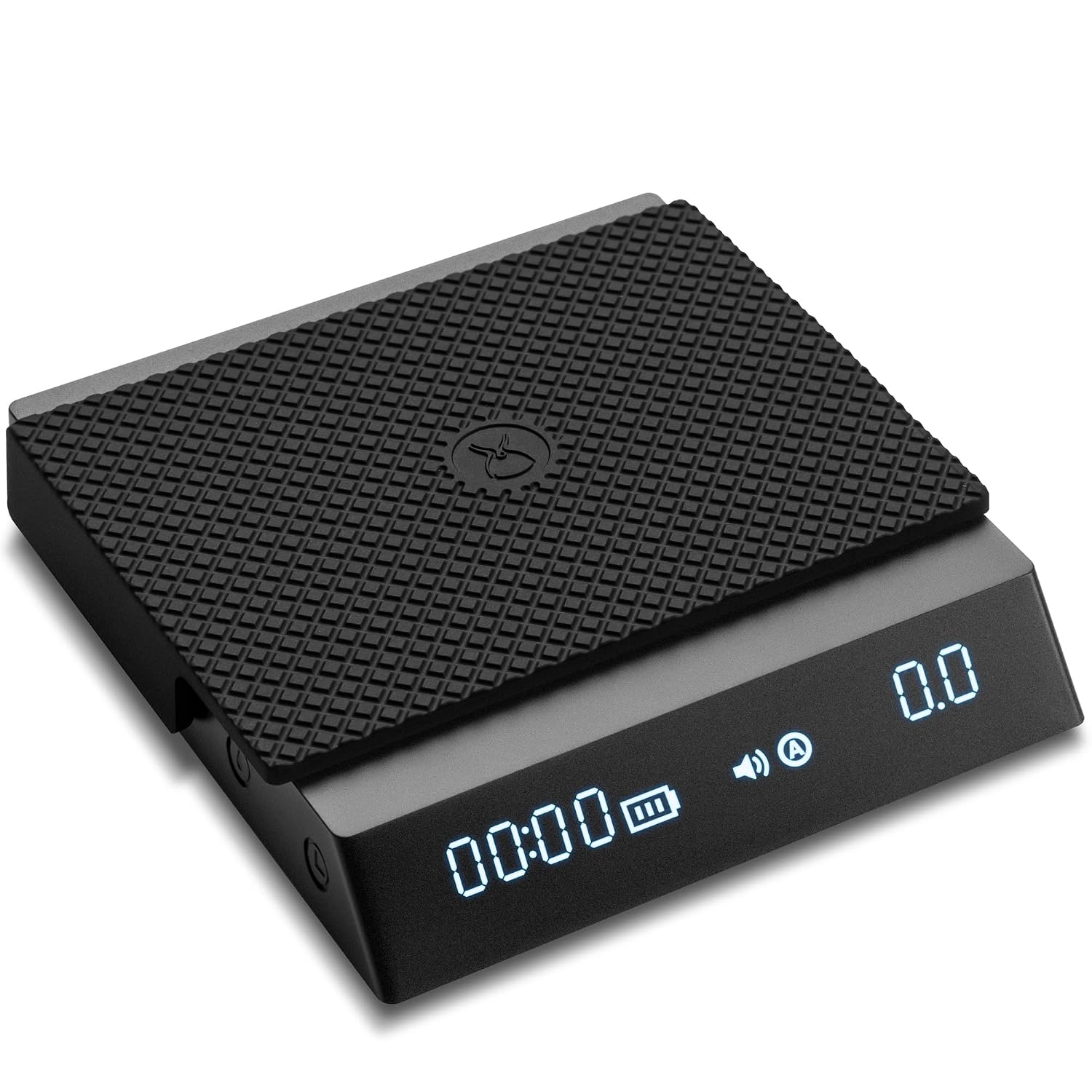
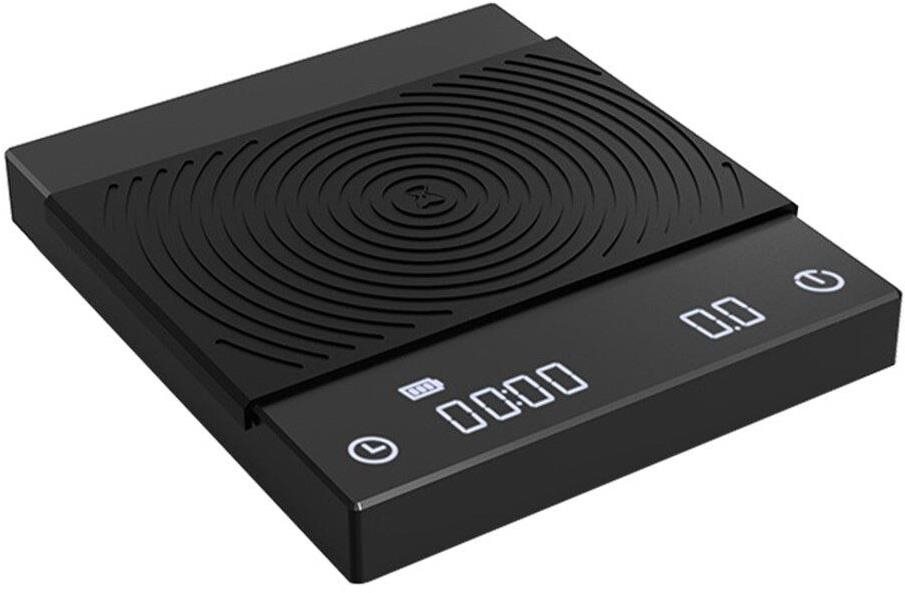
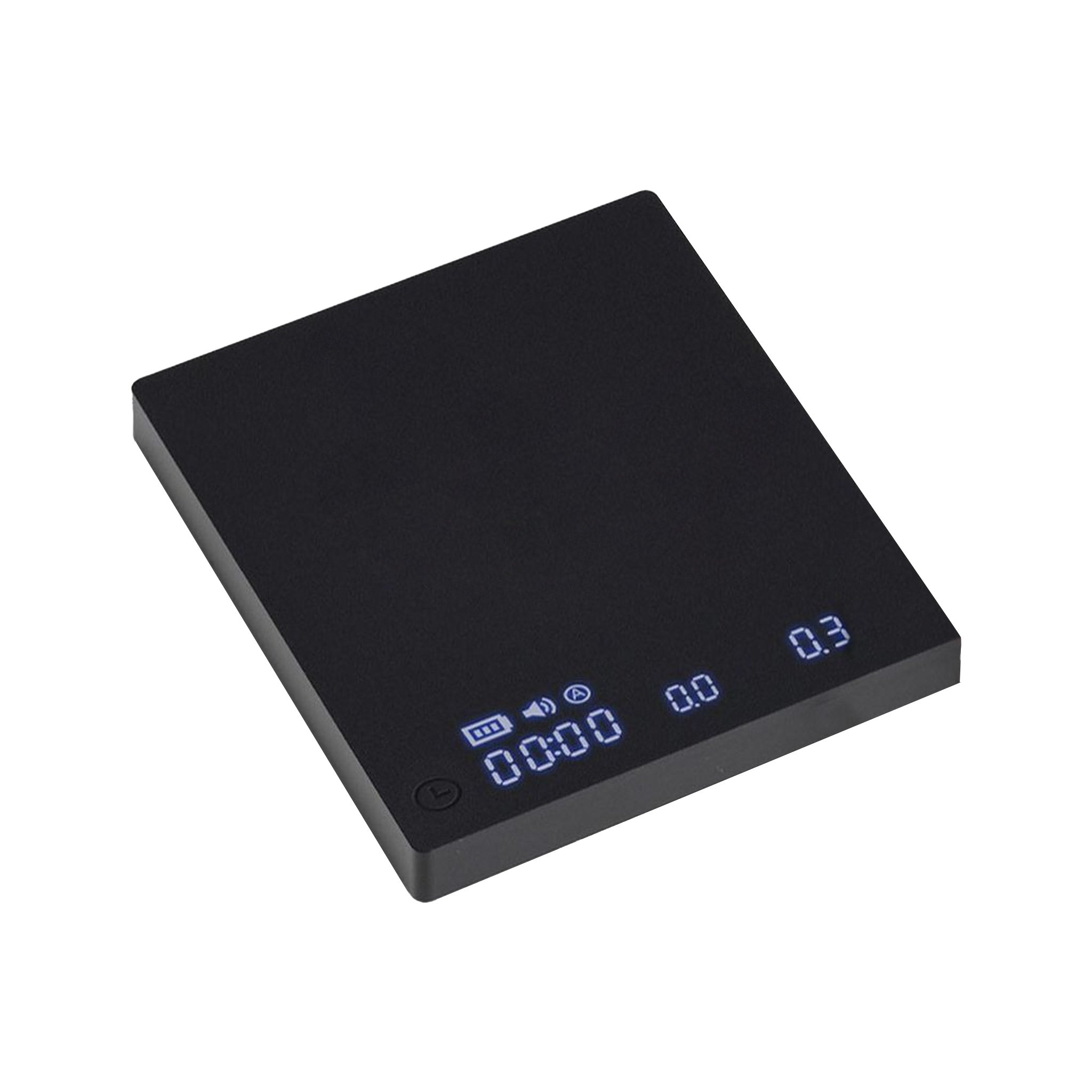
The Timemore Black Mirror Basic 2.0 is the best overall coffee scale for most home brewers, offering 0.1 g resolution, a built-in timer, live flow rate display, and USB-C charging for around $60–70.
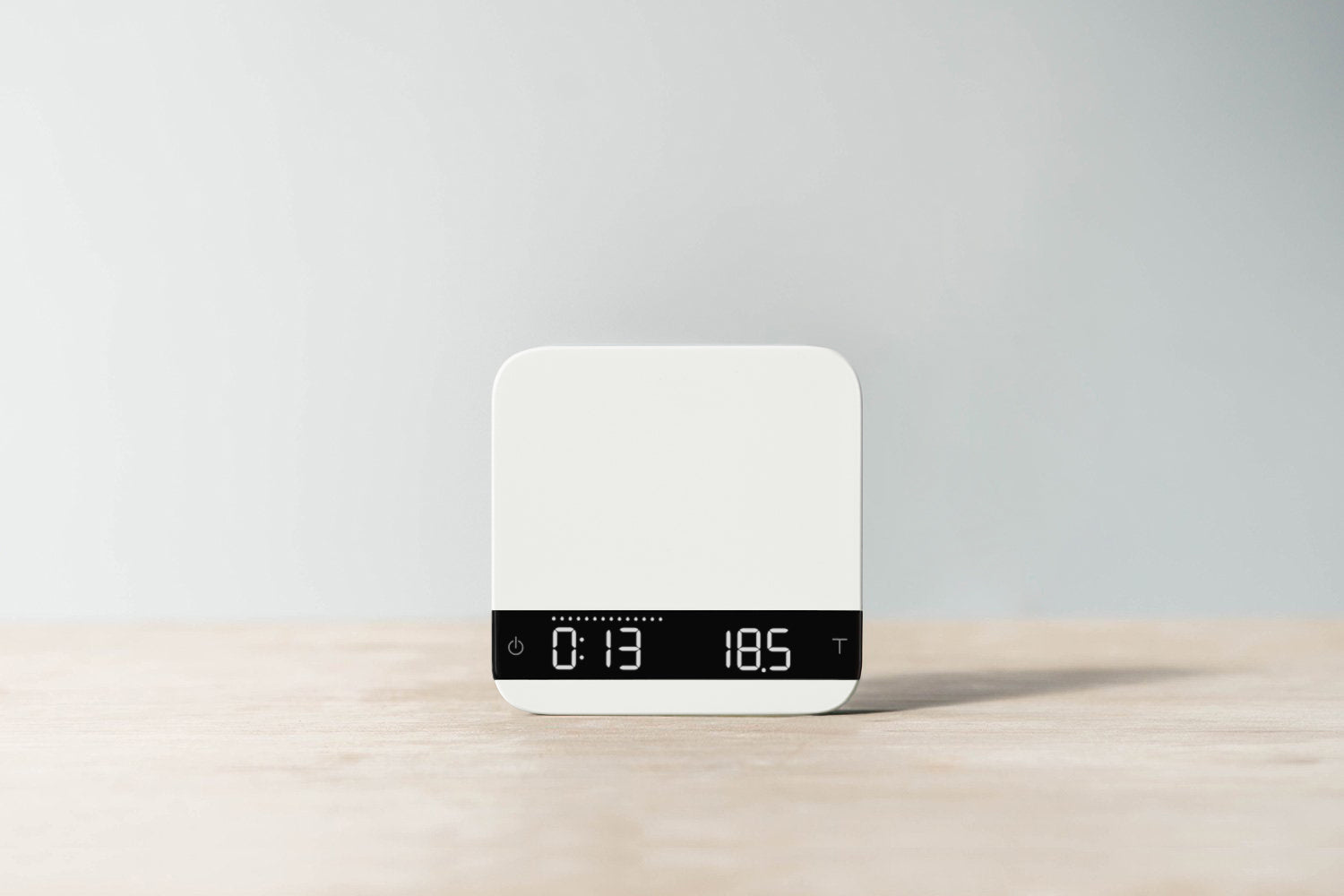
For the best espresso scale, the Acaia Lunar (2021) remains the benchmark with its 20 millisecond response time, water-resistant aluminum body, compact 105 × 105 mm footprint, and advanced auto-timer modes at roughly $250.
Budget buyers can get a solid, accurate scale under $50 that handles pour-over and basic espresso use, though they should expect trade-offs in build quality, water resistance, and display brightness.
A good scale for brewing coffee should deliver at least 0.1 g resolution, fast response, and a footprint that fits your setup, whether that means a compact espresso scale for a tight drip tray or a larger pour-over coffee scale for carafes and batch brewers.
Espresso scales specifically benefit from water resistance, an auto timer or easy manual timer, and compatibility with narrow drip trays, while larger scales are better for pour-over and general kitchen use.
Quick Answer & Top Coffee Scale Picks
For most people making coffee at home, the Timemore Black Mirror Basic 2.0 is the best coffee scale overall. Espresso-focused brewers should look at the Acaia Lunar (2021). And if you’re on a tight budget, a simple coffee scale like the KitchenTour or a basic USB-C compact espresso scale under $50 will get the job done.
Here are the top picks at a glance:
Timemore Black Mirror Basic 2.0 – Best overall for pour-over and espresso. ~$60–70. Standout: live flow rate readout and 0.1 g accuracy on a large platform.
Acaia Lunar (2021) – Best espresso scale for serious shot pulling. ~$250. Standout: 20 millisecond response time and water-resistant machined aluminum body.
Acaia Pearl S – Best smart scale and pour-over scale for data lovers. ~$220. Standout: 3,000 g capacity with Bluetooth brew-guide and espresso mode.
Timemore Black Mirror Nano – Best compact espresso scale for tight drip trays. ~$80–90. Standout: ultra-thin ~20 mm profile designed for compact drip trays.
Timemore Black Mirror Basic Plus – Best value espresso and pour-over hybrid. ~$60. Standout: near-premium performance at a mid-range price.
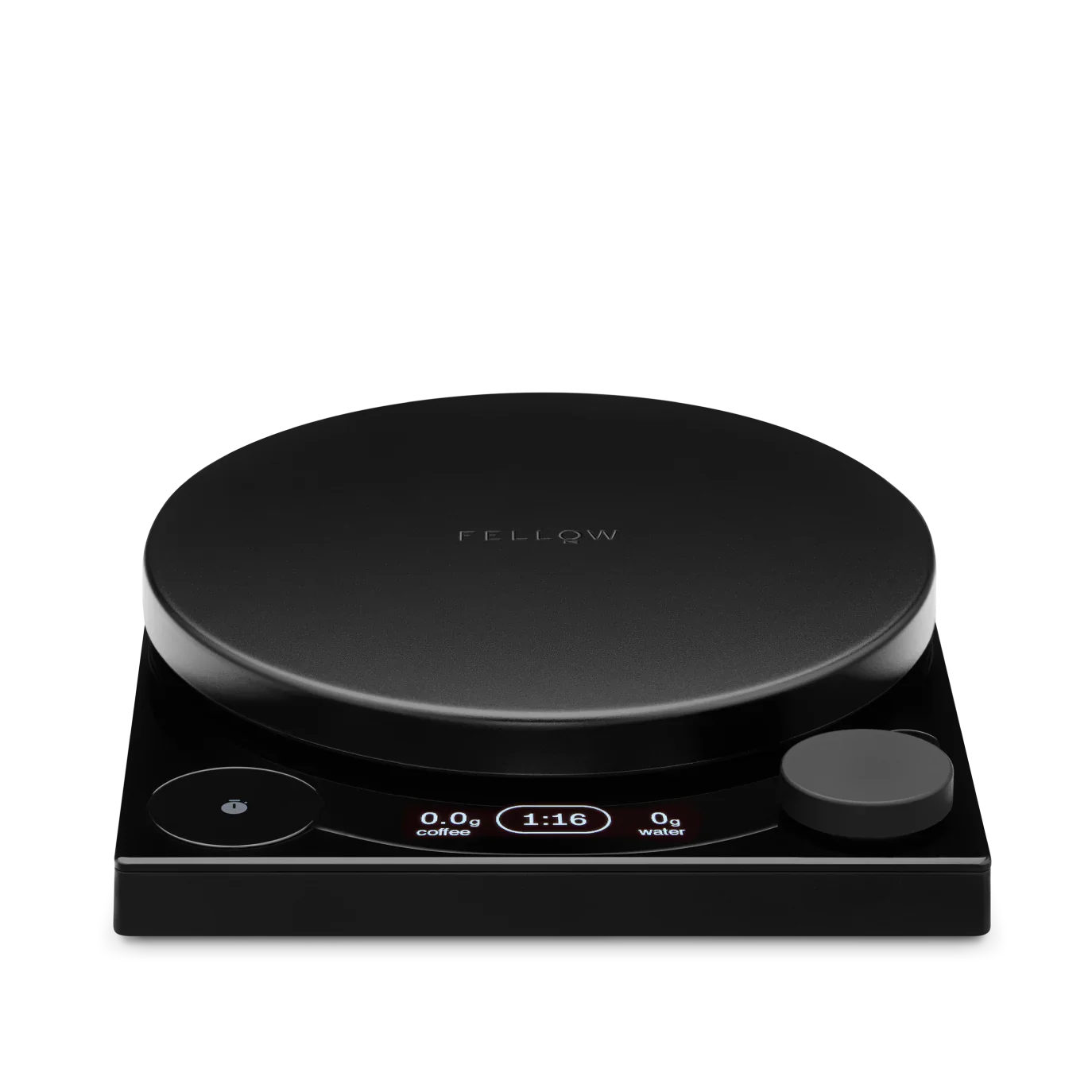
Fellow Tally Pro – Best pour-over scale with guided brewing. ~$100. Standout: automatically calculates target water weight with a maximum capacity of 2,500 grams.
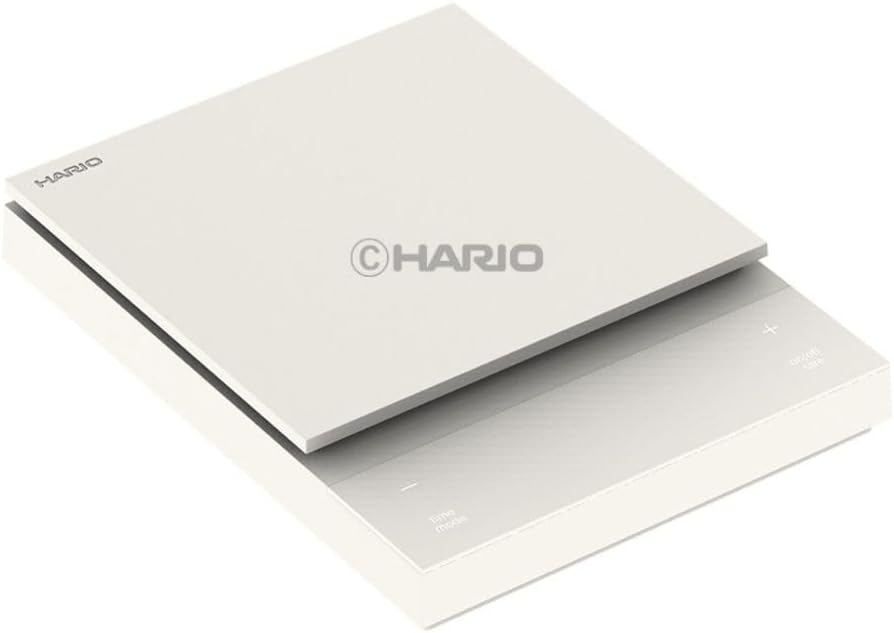
Hario Polaris – Reliable pour-over scale with an automatic timer and slim design. ~$50–70. Standout: clean, fuss-free interface from a trusted Japanese brand.
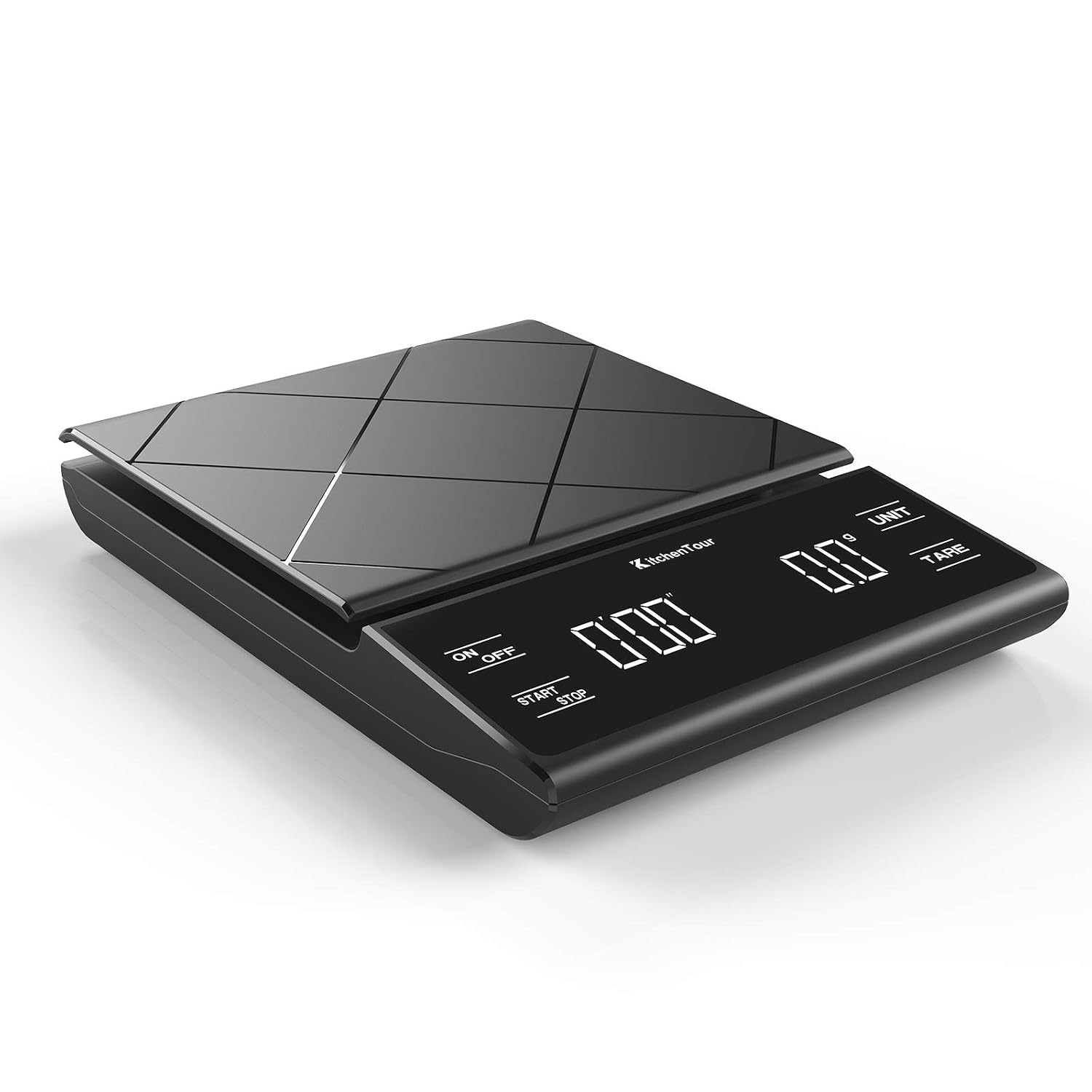
KitchenTour Coffee Scale – Best ultra-budget pick. ~$15–25. Standout: 0.1 g resolution at a price that’s hard to argue with.
At-a-Glance Comparison Table
The table below compares the top coffee scales side by side across accuracy, capacity, footprint, timer features, and value so you can spot the right fit quickly.
This is a researched editorial roundup, not a lab test report. Picks were assembled by cross-referencing manufacturer published specifications, independent performance evaluations from sources like Tom’s Guide and Café Grade, and consensus from barista and enthusiast communities on forums and social media.
The criteria we used to evaluate each scale:
Accuracy and performance: resolution (0.1 g minimum), consistency across repeated measurements, and thermal drift behavior near hot water and steam.
Usability: digital display clarity, button or touch sensitive buttons responsiveness, auto timer behavior, brewing modes, and auto tare functionality.
Capacity and footprint: whether the platform accommodates espresso cups under a portafilter or a full Chemex carafe. Most coffee scales should have a capacity of at least 2 kg.
Durability and materials: aluminum vs. plastic construction, water resistance or splash resistance ratings, and long-term reliability reports.
Cleaning ease, compatibility with espresso machines or pour-over gear, warranty terms, and value relative to what you actually get.
No pick was included solely due to brand prestige or popularity. Each had to demonstrate strong performance, standout features, or unusually good value. For specialty items like an advanced espresso focused scale or Bluetooth Acaia scales, we also considered how many users realistically benefit from those smart features versus simpler alternatives.
Best Overall Coffee Scale for Most Home Brewers
Most people brewing coffee at home do a mix of methods – V60 one morning, AeroPress the next, maybe French press on weekends, and the occasional espresso if their machine allows. A single all-purpose digital coffee scale with 0.1 g resolution, a built-in timer, and a platform large enough for a Chemex covers nearly everything.
The Timemore Black Mirror Basic 2.0 fits this description at around $60–70:
Accuracy: 0.1 g resolution with readings that repeat within roughly ±0.2–0.5 g in third-party tests. Stable enough for espresso dosing and pour-over recipes alike.
Flow rate: Timemore Black Mirror scales feature a built-in flow rate display that shows grams-per-second in real time, helping you control pour speed without a separate app.
Timer and usability: Built-in timer with auto-start detection. The display sits beneath the platform surface – readable in normal light, though viewing angles narrow in bright sun. Some users find the button interface a bit annoying with multiple taps needed for mode switching.
Capacity and platform: Approximately 2,000 g capacity on a ~150 × 150 mm platform, large enough for most manual brewers and carafes.
Power: USB-C rechargeable with reasonable battery life across multiple brew sessions per charge.
Materials: Water-resistant surface coating, though it lacks a formal IP rating. Not fully waterproof, so avoid direct water streams. A rubber mat or silicone pad extends longevity.
Limitations: At ~38 mm thick, it’s too tall for some tight espresso drip trays. No Bluetooth, no advanced brewing modes, and build quality is a step below premium picks. Some users report power switch durability concerns over long-term use.
The real question is whether a coffee scale worth $60 can match a $250 Acaia. For weighing coffee and timing brews, the Basic 2.0 gets you 85% of the way there. The remaining 15% – ultra-low latency, Bluetooth logging, premium water resistance – matters mainly for dedicated espresso dialing or data-obsessed workflows. For the majority of home brewers, this is the sweet spot.
Best Espresso Scale for Serious Shot Pulling
A great espresso scale differs from a standard coffee scale in several ways: it needs a tiny footprint to sit on a drip tray under portafilter spouts, extremely low latency so you can stop your shot at the right gram, water resistance to handle daily splashes, and a display you can read from above while pulling shots.
Dimensions and fit: 105 × 105 × 15 mm – small enough that the Acaia Lunar fits under most espresso machines, including popular models like the Breville Barista Express and Gaggia Classic Pro.
Response time: The Acaia Lunar has a 20 millisecond response time, the fastest among consumer coffee scales. This matters when you need to stop a shot at exactly 36 g and can’t afford 2–3 g of overshoot from display lag.
Accuracy: 0.1 g resolution with an optional 0.01 g high-readability mode. Espresso scales should measure with 0.1 gram accuracy, and the Lunar exceeds that standard.
Timer and modes: Auto-start timer that detects when liquid hits the cup, espresso mode with tare-save functionality, and a flow rate indicator. Multiple brewing modes can be cycled through, though the learning curve is noticeable.
Water resistance: Anodized aluminum body with water-resistant construction. Acaia’s warranty covers water damage for two years – a rarity among other scales.
Battery: USB-C rechargeable, approximately 30–40 hours of continuous use depending on display brightness.
Bluetooth: Connects to the Acaia app for shot logging, brew curves, and firmware updates. A few scales match its accuracy, but none match its ecosystem.
The drawbacks are real: at ~$250, it’s roughly four times the cost of a Timemore Black Mirror Basic. The multiple modes and symbols can feel unintuitive at first. And the small platform makes it impractical for large pour-over brews or mixing bowl use.
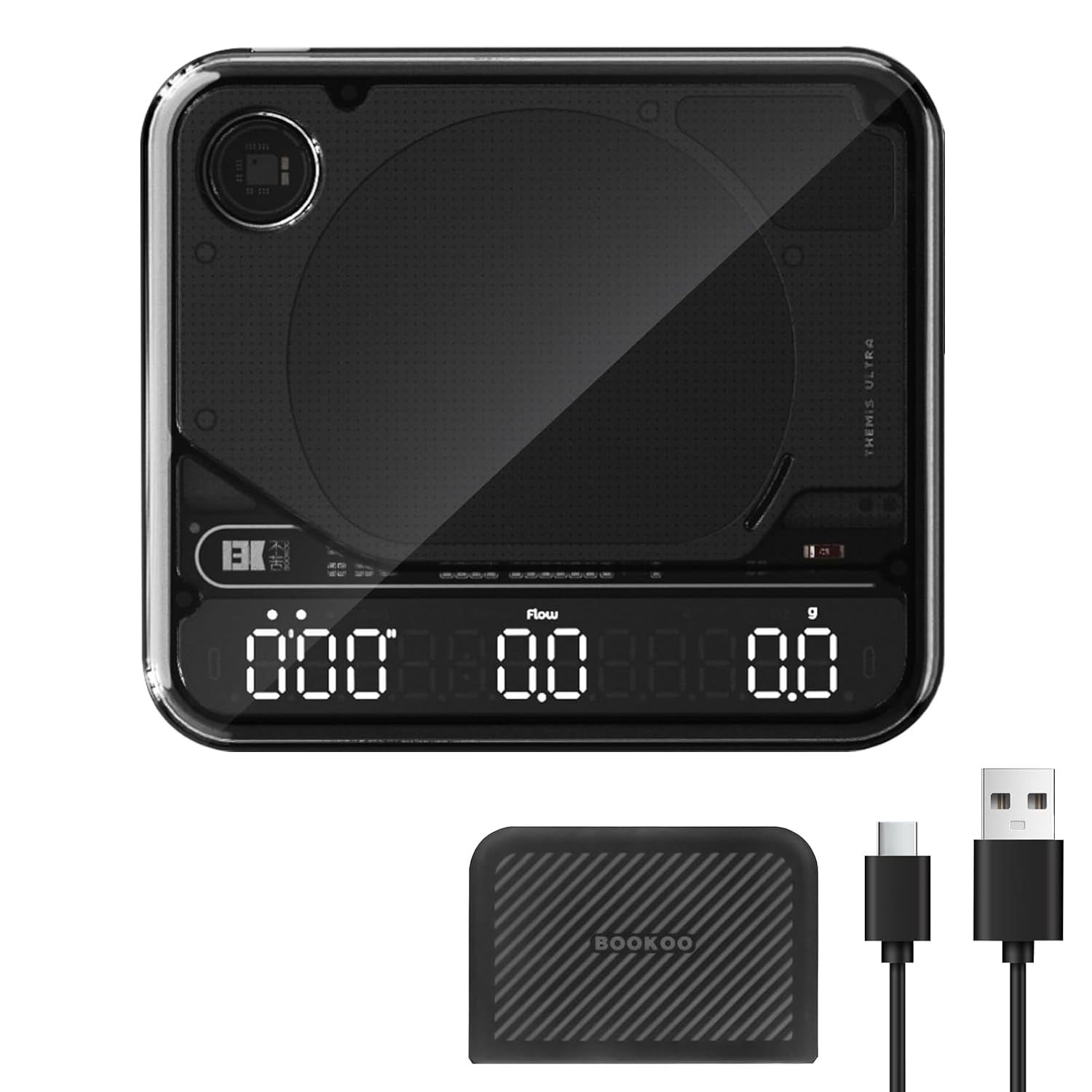
Among alternatives, the Bookoo Themis Ultra is waterproof with an IP67 rating and costs significantly less, making it worth considering if water resistance is your top priority over response speed.
Ideal for: home baristas pulling shots daily, prosumer setups, and anyone who wants a durable, water-resistant espresso scale that will last years.
Best Budget Coffee Scale (Under $50)
Not everyone needs Bluetooth or machined aluminum. Basic budget-friendly scales typically lack advanced features but offer solid accuracy – and that’s often enough for someone just starting to weigh their coffee instead of scooping it.
At around $15–25, the KitchenTour Coffee Scale and similar options deliver:
Accuracy: 0.1 g resolution in many models, though readings can be slightly less stable at very low weights (under 5 g) compared to premium picks.
Response: Slower update speed than mid-tier and premium scales – you’ll notice a lag when pouring, which can make hitting a target weight precisely a bit harder for making espresso.
Power: Often AAA batteries rather than USB-C rechargeable, which adds a small ongoing cost. Some newer budget models include USB charging.
Build: Plastic housing, thinner load plates, and minimal splash resistance. Displays tend to be dimmer with narrower viewing angles. No formal water resistance ratings.
Features: Basic timer (usually manual start), tare function, and not much else. No flow rate, no brewing modes, no Bluetooth.
To extend lifespan at this price tier, avoid direct water contact with the scale displays and buttons, wipe spills immediately instead of rinsing, and store away from steam. A small scales protective case or mat helps.
The Timemore Black Mirror Mini measures 100 × 114 mm and weighs 192 g, sitting in the $50–60 range – just above this budget category but worth mentioning for anyone willing to stretch slightly for better build quality and the Black Mirror Mini’s 0.1 g measurements.
Ideal for: first coffee scale buyers, students, anyone upgrading from a baking scale to improve pour-over consistency, and brewers who just need a simple coffee scale that handles the basics.
Best Coffee Scale for Pour-Over & Manual Brewing
Pour-over brewers need a different set of priorities than espresso drinkers. Larger scales are preferred for pour-over setups to accommodate carafes – a Chemex or large Kalita Wave server won’t fit on a 105 mm espresso scale. The best pour-over scales measure accuracy to 0.1 grams, have clear timer and weight readouts visible from a standing position, and won’t auto-off in the middle of a 3–4 minute brew.
The Acaia Pearl S stands out as a dedicated pour-over coffee scale:
Capacity: The Acaia Pearl S has a maximum capacity of 3,000 grams, handling large batch brews and full carafes without maxing out.
Platform: Broad enough for a Chemex, V60 with server, or flat-bottom brewers. Scale displays weight and time simultaneously.
Brew assist mode: App-guided brew recipes, ratio mode, and flow rate monitoring for pour-over. These brewing modes help dial in repeatable recipes, particularly useful when you’re groggy and want the scale to calculate ratios for you.
Bluetooth: Connects to the Acaia app on iOS and Android for brew-curve logging and recipe sharing.
Build: Premium materials and construction with a silicone pad for heat protection.
The Fellow Tally Pro is another strong pour-over scale – it automatically calculates target water weight based on your dose and chosen ratio, with a maximum weight capacity of 2,500 grams. Pour-over scales often include built-in timers for brewing, and the Tally Pro executes this cleanly.
Many coffee scales include built-in timers for brewing, but pour-over scales in particular benefit from auto-off behavior that doesn’t interrupt a long steep. Most coffee scales with aggressive auto-off (common in kitchen scales and some budget picks) will shut down mid-brew, losing both your timer and your weight reference.
Limitations: these larger pour-over scale platforms are often too big for smaller espresso machine drip trays, and they may lack explicit water-resistance ratings needed for heavy espresso use.
Best Compact Travel & Espresso Scale
Travelers and owners of espresso machines with narrow drip trays need a tiny scale that doesn’t sacrifice accuracy. The Timemore Black Mirror Nano is designed for compact drip trays with an ultra-thin profile of approximately 20 mm, making it one of the thinnest espresso scales available.
Key details on compact options:
Dimensions and weight: The Nano and similar Palm-style scales typically measure under 10 cm on each side and weigh under 200 g, slipping easily into a travel bag or dosing cup pouch.
Accuracy: 0.1 g resolution with fast response, suitable for both espresso and pour-over and espresso when you’re on the go.
Timer: Manual or auto start timer, though fewer brewing modes than full-size models.
Power: USB-C rechargeable in most current models. Battery life is shorter than larger scales due to smaller cells.
Protection: Some include a protective case or cover. Splash resistance varies – look for sealed USB port covers if your machine produces backflush spray.
Display visibility: Compact size is necessary for scales used with espresso machines to fit on drip trays, but the trade-off is a smaller digital display. Reading the screen with a demitasse or shot glass on top can require angling your head.
Compromises are real: a tiny scale isn’t comfortable for large pour-over carafes, may feel unstable under a heavy mug, and typically lacks the brew assist features of larger models.
Ideal for: frequent travelers, compact espresso machine owners, and anyone who wants a secondary espresso scale that fits in a messenger bag alongside their Flair brew scale or portable setup.
Best Smart & Bluetooth-Enabled Coffee Scale
A smart scale connects to your phone via Bluetooth to log shots, graph brew curves, save recipes, and sometimes receive firmware updates. Some coffee scales can connect to apps for tracking brews, and for data-loving brewers this is genuinely useful.
The Acaia Pearl S and Acaia Lunar lead this category:
Connectivity: Bluetooth 5.0 with dedicated iOS and Android apps. The Acaia app offers guided recipes, live flow-rate curves, espresso mode logging, and community recipe sharing.
Offline function: Both work perfectly as standalone scales without the app – the smart features are additive, not required.
Other options: The Bookoo Themis Ultra has an IP67 waterproof rating and offers basic app connectivity at a lower price, though its app ecosystem is less mature. Higher-end coffee scales provide advanced features like Bluetooth connectivity for tracking brewing data, and this segment is growing.
Trade-offs worth considering:
Higher upfront cost ($200+ for Acaia scales versus $60–80 for non-connected alternatives).
App stability matters: if the developer drops support, you lose smart features. The scale should still function well without connectivity.
Bluetooth can drain battery faster, and some users find the coffee making process simpler without app notifications.
Most home brewers don’t log every brew – favorite scales are often the ones that just work without fuss.
A smart scale is worth it for competition-level brewers, baristas building a recipe library, and odyssey espresso enthusiasts who want per-shot data. For everyone else, a good brew comes from consistent technique, not necessarily from a connected scale.
Key Features That Matter in a Coffee Scale
All modern coffee scales measure weight. The real differences are in workflow, durability, and how well features serve your brewing style.
Accuracy and resolution: Coffee scales should have a precision of 0.1 g for accurate brewing. Coffee scales measure in increments as small as 0.1 grams, which matters for espresso dosing and precise pour-over ratios. Some models offer 0.01 g readability, but noise and drift often make this impractical.
Responsiveness (latency): Fast response time is critical for espresso and pour-over brewing. A 20 ms response (Acaia Lunar) versus a 200 ms response means the difference between stopping at your target weight and overshooting by 3–4 g.
Capacity: Most coffee scales should have a capacity of at least 2 kg. For batch brewing, look at 2,500–3,000 g models.
Footprint: Espresso-focused scales are small and thin. Pour-over and multi-use scales have larger platforms. Measure your drip tray or brewer before buying.
Display: Brightness, viewing angle, and digit size affect usability. Scale displays should be readable in low light, especially for early-morning coffee shop routines at home.
Timer: A built-in timer allows tracking of both weight and brew time simultaneously. Auto timer modes start when flow is detected; manual timers require a button press. Both work.
Brewing modes: Ratio calculation, brew assist, espresso mode, and flow rate indicators vary by model. High-end coffee scales can monitor flow rates during brewing. Useful but not essential for a good cup.
Flow rate monitoring: Coffee scales often include features like flow-rate monitoring for improved brewing results, showing grams per second during pours.
Auto tare: Auto-tare functionality simplifies weighing by automatically zeroing the scale when you place a vessel, saving a step.
Water resistance: Coffee scales often feature water-resistant designs for durability. Water resistance is important for longevity in coffee scales due to spills. Ranges from basic splash resistance to full IP67.
Materials: Aluminum bodies outlast plastic. Silicone pads protect from heat. Rubber mat accessories add grip.
Power: USB-C rechargeable batteries offer convenience over disposable batteries. AAA batteries add ongoing cost and waste.
Value: A coffee scale worth buying delivers accuracy, durability, and usability proportional to its price. A $250 scale should meaningfully outperform a $60 one – if it doesn’t for your needs, save the money and spend it on better coffee beans.
How to Choose the Best Coffee Scale for Your Setup
Match the scale to your primary brewing method and counter space rather than chasing every feature. A brewer who makes pour-over coffee every morning and pulls espresso shots on weekends has very different needs than someone who exclusively uses espresso machines.
Primary method: Espresso-first? Prioritize compact footprint, low latency, and water resistance. Pour-over-first? Go for a larger platform, clear display, and timer that doesn’t auto-off.
Machine dimensions: Measure the space between your portafilter spouts and the drip tray. Many espresso machines leave fewer than 70 mm of clearance – only a few scales fit.
Accuracy needs: 0.1 g is enough for both espresso and pour-over. Finer resolution is rarely worth the cost.
Timer preference: An automatic timer that starts on contact is convenient but can misfire during bloom or pre-infusion. Manual control is simpler and more predictable.
Smart features: Only pay for Bluetooth or brewing modes if you’ll genuinely use them. Most people don’t need app logging for a good brew.
Capacity vs. footprint: Need to weigh large batches of cold brew or fill a mixing bowl? Get a 3,000 g capacity scale. Only pulling 36 g espresso shots? A 1,000–2,000 g compact model is plenty.
Longevity: Consider build quality, seals and gaskets for water, cleaning ease, and warranty terms. A two scales strategy – one budget, one premium – sometimes costs less over five years than repeatedly replacing cheap ones.
Compatibility: Think about how the scale pairs with your gooseneck kettle workflow, your dosing cup, and whether it can double for measuring beans into storage containers or your grinder hopper.
Using a Coffee Scale for Better Espresso
An espresso scale transforms shot consistency by letting you work with a brew ratio – say 1:2 – instead of relying on time alone. Accuracy in coffee brewing affects flavor consistency, and nowhere is this more obvious than with espresso.
Here’s a simple workflow:
Weigh beans: Place your dosing cup on the scale, tare, and measure out your dose. A standard espresso shot requires 18 grams of coffee.
Confirm dose: After grinding, tare the portafilter on the scale and verify the ground weight. A 1 g error in an 18 g espresso dose is a 5.5% variance – enough to shift extraction yield and flavor noticeably.
Tare cup: Place your cup on the espresso scale under the portafilter spouts, tare to zero.
Pull the shot: Start your shot and watch the weight climb toward your target weight (e.g., 36 g for a 1:2 ratio). Stop the machine when the display is 1–2 g below target to account for residual drip.
Record and adjust: Note your dose, yield, and time. Compare against taste.
Low latency and a clear display are crucial here – overshooting by 3–4 g can meaningfully change extraction and flavor. Auto tare and an auto start timer help speed things up, but some baristas find auto modes mis-read pre-infusion drip or cup placement and prefer manual control when pulling shots.
Compact espresso scales with heat-resistant pads and water resistance handle daily splashes, drips, and backflush water far better over time than a generic kitchen scale.
Using a Coffee Scale for Pour-Over & Other Brew Methods
Weighing coffee ensures consistent coffee-to-water ratios, which is the foundation of repeatable pour-over coffee. Using weight-based ratios (e.g., 15:1 or 16:1 coffee to water ratio) instead of scoops eliminates a major variable.
A typical pour-over routine with a scale:
Weigh beans: 20 g is a common single-cup dose. Place beans on the scale, measure, then grind fresh.
Prepare brewer: Set your dripper and filter on the scale, tare.
Add grounds: Pour in 20 g of ground coffee, tare again.
Bloom: Start the timer, add approximately 40 g of hot water, and let it bloom for 30–45 seconds.
Pour to target: Continue pouring in slow circles to your target water weight – 300 g for a 15:1 ratio – while monitoring the timer and flow rate if your scale provides it.
Brewing modes like ratio or brew assist can simplify mental math for larger batches. The Fellow Tally Pro automatically calculates target water weight based on your inputted dose and ratio, removing arithmetic from a groggy morning routine.
For immersion methods like French press or AeroPress, a scale sets consistent doses and brewing volumes. Even cold brew benefits: measuring beans and water by weight instead of volume produces more repeatable results.
Dedicated coffee scales are preferred over kitchen scales here because aggressive auto-off behavior – common on a baking scale – can shut the display off mid-brew, ruining your timing and measurement.
Maintenance, Cleaning & Cost of Ownership
A quality coffee scale can last many years if you protect it from moisture and physical shocks. Here’s how to get the most life out of yours:
Use a mat: Always use the included silicone or rubber mat if provided. It protects the load cell from heat and adds grip. If your scale didn’t come with one, a thin silicone coaster works.
Wipe, don’t rinse: Clean spills immediately with a damp cloth. Never submerge the scale or run it under water, even if it’s rated water-resistant. Avoid placing extremely hot carafes directly on unprotected surfaces.
Store smart: Keep the scale away from steam vents and don’t leave it on the drip tray when backflushing.
Calibration: Calibrate every few months using a calibration weight (many premium scales include a 100 g weight). A known coin can work for quick checks. Calibration matters for espresso brew ratios where grams translate directly to taste.
Battery life: USB-C rechargeable scales cost pennies per year to power. Models using AAA batteries cost more over time – roughly $10–20/year depending on usage. Rechargeable batteries degrade over years but are typically sufficient for 3–5 years of normal use.
Total cost of ownership: A $250 scale with a 2-year warranty that lasts 5+ years may actually cost less per year than a $25 scale that fails after 12–18 months. Consider purchase price, battery or charging costs, and whether a generous warranty protects your investment. Small scales with plastic housings are most vulnerable to cracks and moisture damage.
Accuracy, Performance & Common Coffee Scale Questions
Many readers worry about specs like 0.1 g accuracy, thermal drift, and fluctuating readings while brewing. Here’s what to know:
Why 0.1 g resolution: For espresso doses of 18 g, a 0.1 g increment gives you meaningful control. For pour-over, it helps hit target water weight precisely. Coffee scales measure in increments of 0.1 grams, which is the standard for both espresso and pour over.
When 1 g is fine: For large batch brews (300–600 g water), French press, or cold brew, 1 g resolution is acceptable. The error percentage is tiny relative to other variables.
Thermal drift: Hot water and steam can temporarily affect load cell readings. Quality scales include insulating pads; fluctuation of ±0.2–0.5 g is normal near heat. Persistent drift beyond that suggests a quality issue.
Premium vs. mid-tier performance: While Acaia scales and other premium models advertise ultra-fast response and tight tolerances, most home users will be well served by solid mid-tier picks like the Timemore Black Mirror Basic or Basic Plus if they brew consistently and control grind, water temperature, and dose.
Related Gear for Better Brewing
A coffee scale is one piece of a broader brewing toolkit. Pairing it with the right accessories makes the biggest difference in your cup.
A precision coffee scale pairs naturally with a gooseneck kettle for controlled pour-over pours – look for our guide to the best gooseneck kettles at /gear/accessories/best-gooseneck-kettles/.
Scales are also useful alongside quality milk texturing tools for latte art and steamed drinks. See our roundup of the best milk frothers at /gear/accessories/best-milk-frothers/.
Weighing coffee beans for storage is just as important as weighing them for brewing. Check out the best coffee storage containers at /gear/accessories/best-coffee-storage-containers/.
For grinders, filters, water-quality tools, and more, explore the full brewing accessories hub at /gear/ and /gear/accessories/.
FAQ
These FAQs address common questions about coffee scales that aren’t fully covered in the sections above.
Can I just use a regular kitchen scale instead of a coffee scale?
You can, but you’ll likely notice limitations. Many kitchen scales only offer 1 g resolution, have aggressive auto-off timers that shut down mid-brew, and respond too slowly for espresso work where every gram counts. For large-batch brewing – say, a 1-liter French press – a kitchen scale works in a pinch. But for espresso doses where a 1 g error on an 18 g dose represents a 5.5% variance, or for timed pour-over recipes, a dedicated coffee scale with 0.1 g increments and a built-in timer makes a meaningful difference in consistency. Most kitchen scales also lack flow rate displays and water resistance, two features that simplify the coffee making process and protect the scale from daily use in a wet environment.
Do I really need an auto timer or brewing modes on my coffee scale?
Not strictly. A phone timer or a manual button press works fine, and plenty of excellent coffee is brewed without any auto modes at all. Auto timers and brewing modes are conveniences: they free up a hand, automate ratio math, and help with repeatability. But they can also misfire – auto-start timers may trigger when you shift the brewer during bloom, or during espresso pre-infusion before actual flow begins. If these quirks sound like they’d be a bit annoying rather than helpful, a simple coffee scale with a manual timer is perfectly adequate for a good brew. Brewing modes like brew assist and ratio mode shine most when making coffee in larger batches or for people who don’t want to do mental math at 6 AM.
How water-resistant should my espresso scale be?
At a minimum, your espresso scale should tolerate surface splashes from portafilter drips and occasional spills. Basic splash resistance – a sealed top plate and protected buttons – handles most home use if you wipe up promptly. For setups where backflushing sends water across the drip tray regularly, or where you’re less careful about splashes, look for scales with formal water-resistance ratings. The Bookoo Themis Ultra, for example, carries an IP67 waterproof rating. The Acaia Lunar is water-resistant with warranty coverage for water damage. If your budget is limited and your scale lacks strong water resistance, careful workflow – removing the scale before backflushing, keeping a towel handy – can protect it, but you’ll always be one careless moment away from trouble.
Is a Bluetooth smart scale worth it for home brewing?
For most home brewers, no. Bluetooth and app features are most valuable for people who log every shot, analyze brew curves over time, or share recipes with a community. If you pull two shots a day and want to track extraction yield, dose, and grind changes systematically, a connected Acaia scale with its app ecosystem genuinely helps. But if you brew casually and adjust by taste, a non-connected scale with a timer delivers identical flavor results for a fraction of the cost. One practical concern: apps can be discontinued or lose compatibility with phone updates, so the scale should still function fully as a standalone device. Among top coffee scales, the Acaia Pearl S and Lunar handle this well, working perfectly without the app for basic weighing and timing.
How long should a good coffee scale last?
With normal home use – a few brew sessions per day – a well-built coffee scale should last three to five years or more. Metal-bodied scales like the Acaia Lunar tend to outlast plastic alternatives. The most common failure points are power switches (especially touch-sensitive ones), battery capacity degradation, and moisture damage to internal electronics. Warranties typically run one to two years; Acaia offers two years including water damage coverage on the Lunar. Beyond warranty, longevity depends on how well you protect the scale from drops, steam, and standing water. Treating a $60 scale carefully can push it well past two years; neglecting a $250 scale can kill it in months. Regular calibration, prompt spill cleanup, and storing away from heat sources are the simplest ways to extend lifespan.
How Capitol City Coffee Rates Coffee and Coffee Machines
Every coffee and coffee machine we recommend is scored on the same 100-point scale, so a recommendation on one page means the same thing as a recommendation on any other. Each pick is also labeled with how we reached its score.
Research-ratedScored from the roaster or manufacturer’s published specifications, independent results such as Coffee Review blind cuppings and SCA brewer certification, and patterns across verified buyer reviews. Most of our current picks are research-rated.
Hands-on testedThe Capitol City Coffee team has brewed the coffee or used the machine ourselves, following the testing steps below. We only use this label when that testing actually happened, and we show the date we tested.
Coffee beans: 100-point scale
What we score
Points
What we look at
Origin and sourcing transparency
20
Country, region, farm or cooperative, altitude, bean variety, and processing method are clearly disclosed.
Flavor evidence
25
Independent cupping scores, how closely the tasting notes match what the origin is known for, and our own cupping notes when hands-on tested.
Roast and freshness
15
Roast level stated, roast-date practices, whole-bean availability, and packaging with a one-way valve or resealable bag.
Brew versatility
15
How well the roast suits pour-over, drip, French press, cold brew, and espresso.
Value
15
Price per ounce compared with similar single-origin coffees or blends.
Buyer feedback
10
Volume and consistency of verified reviews, and recurring complaints about staleness, bitterness, or shipping.
Coffee machines and gear: 100-point scale
What we score
Points
What we look at
Brewing performance
25
Water temperature in the 195–205°F range, even extraction, and SCA certification or published test data.
Build quality and reliability
20
Materials, known failure points, and long-term owner reports.
Ease of use and cleaning
15
Setup, the daily routine, descaling, and dishwasher-safe parts.
Fit for your kitchen
10
Capacity, counter footprint, and noise.
Useful features
10
Programming, grind and temperature control, and carafe type. Features that improve the cup count more than extras that do not.
Value
10
Price compared with machines that perform similarly.
Warranty and support
10
Warranty length, parts availability, and how the brand handles repairs.
What the grades mean
Score
Grade
What it means
90–100
A
Exceptional. Our first recommendation for the feeling and setting described.
80–89
B
Strong. Excellent, with minor trade-offs we explain.
70–79
C
Good. Worth it for specific needs, with clear compromises.
Below 70
—
Not recommended. We do not feature these as picks.
How we test hands-on
When a pick carries the Hands-on tested label, this is the method behind it, and we note the date we tested.
Coffee: brewed fresh from whole beans following Specialty Coffee Association guidelines (water between 195 and 205°F, about 1 gram of coffee to every 15 to 18 grams of water) in the brew methods the roast suits best, such as pour-over, French press, or espresso. We taste it black first, then with milk if that is how most people drink it, and each taster scores it on their own before we compare notes.
Machines: used in our everyday routine rather than a single demo. We brew both full and small batches, check the brewing temperature and brew time, and run the cleaning or descaling steps the manual calls for.
How we choose the feeling and setting
We match each coffee to a mood and a moment based on its flavor profile and roast. Bright, citrusy light roasts suit energizing mornings. Chocolatey, full-bodied medium roasts suit slow or social moments. Richer roasts suit espresso and milk drinks. Each pick explains which facts led us to that match.
Our scores stay independent
Every score comes only from the criteria above. No brand can pay for a pick or a higher grade. We re-check ratings when a roast, listing, or model changes, and update or remove picks that no longer earn their grade.
Some links on this page are affiliate links. As an Amazon Associate, Capitol City Coffee earns from qualifying purchases, at no extra cost to you.
Questions about a rating? Reach the Capitol City Coffee team through our contact page.