
Certified coffee is coffee whose farming, processing, or trading practices have been verified by an independent organization against published standards. Common coffee certifications include Organic, Fairtrade, Rainforest Alliance, and Bird Friendly, each focusing on different goals such as environmental protection, labor conditions, and economic sustainability. This page breaks down what each label means, what it does and does not guarantee, and how to pick beans that match your priorities.
Key Takeaways
- Coffee certification means a product meets standards set by a third-party organization; certification ensures practices claimed on coffee bags actually happened through independent auditing.
- The most common certified coffee labels in the U.S. are USDA Organic, Fairtrade, Rainforest Alliance, and Bird Friendly. Sourcing terms like Direct Trade are defined by individual roasters, not by universal third-party standards.
- No single certification guarantees perfect ethics or great flavor. Certifications reduce risk and improve transparency, but they add cost and cannot monitor every transaction in the supply chain.
- Capitol City Coffee is an independent educational and affiliate publication, not a roaster or retailer. Recommendations on this site are based on researched editorial analysis from reputable sources, not firsthand tasting or ownership.
- A certification does not guarantee coffee taste or quality in the cup; taste depends on origin, processing, freshness, and roast profile.
At a glance
Direct Overview: What “Certified Coffee” Actually Means
For coffee to be certified means an independent organization has audited its standards against a published set of criteria. These programs cover environmental, social, or economic practices at the farm and supply chain level. Roaster-defined sourcing terms like Direct Trade or relationship coffee are separate from formal certifications; they lack a universal auditing body.
The most common certifications on U.S. retail bags are:
- USDA Organic: bans synthetic pesticides, herbicides, and GMOs; requires three years of compliant farming.
- Fairtrade International / Fair Trade USA: sets minimum prices and premiums for cooperatives.
- Rainforest Alliance / UTZ Certified: broad environmental and social standards across large-scale coffee production.
- Smithsonian Bird Friendly: requires certified organic plus strict shade grown habitat criteria.
Sourcing approaches like Direct Trade, specialty grading (80+ SCA cupping scores), and traceable microlots add further layers of quality and transparency. Certified products are available in U.S. grocery stores, subscription services, and specialty coffee roasters, and may include coffee or tea, typically at a modest price premium over conventional coffee.
The rest of this page helps you decode labels, understand trade-offs, and choose beans that match your ethics, taste preferences, and budget.
Why Coffee Certifications & Sourcing Choices Matter
Coffee is one of the world’s most traded agricultural commodities. Millions of smallholder farmers depend on volatile global markets, and coffee expansion drives deforestation, chemical runoff, and habitat loss. Certifications respond to these pressures with verifiable standards.
- Farmer income and price volatility: The New York “C price” for Arabica swings unpredictably. Fairtrade International’s minimum price for washed Arabica will rise to US$2.00 per pound on December 1, 2026, up from US$1.80, helping producers cover rising input costs when market prices drop. Certified coffee supports climate-resilient farming practices by funding preparation and adaptation through premiums.
- Environmental pressures: Deforestation, loss of shade grown systems, and pesticide use threaten soil, water, and wildlife. Organic farming practices ban synthetic pesticides and fertilizers; Rainforest Alliance prohibits conversion of natural ecosystems; Bird Friendly certification requires dense canopy that supports biodiversity.
- Consumer trust and traceability: Certification seals, QR codes, and disclosed farm names help consumers move beyond vague marketing materials. Transparency in the supply chain matters more than buzzwords.
- Limitations: Certification standards add costs (audit fees, recordkeeping, ongoing compliance), which can exclude the smallest farms. Certifications reduce but do not eliminate ethical and environmental risk.
- Capitol City Coffee’s role: This site helps readers interpret labels, weigh trade-offs, and navigate the certified coffee landscape through independent editorial research.
Key Certification & Sourcing Types (Organic, Fair Trade, RFA, Bird Friendly, Direct Trade)
This section is a practical guide to the most common coffee certifications and sourcing terms found on U.S. retail bags. Each subsection covers what the label guarantees, who oversees it, and what it does not cover.
Certified Organic Coffee
USDA Organic is the primary organic standard for coffee sold in the U.S. USDA Organic certification prohibits synthetic pesticides and GMOs. Farms must avoid synthetic fertilizers and herbicides for at least three years, maintain approved input lists, and submit to annual inspections. Organic coffee certification is verified by third-party organizations accredited by the USDA.
USDA Organic focuses strictly on agricultural inputs and environmental health. Organic coffee certification requires detailed farming practice records at every step: farm, mill, exporter, importer, roaster. USDA Organic certification supports biodiversity and ecosystem balance by promoting soil health and reducing chemical runoff.
What organic does not guarantee: shade cover, habitat protection, farm wages, or flavor. Natural inputs (certain botanicals, composts) are still allowed under organic practices, so “organic” does not mean zero pesticide exposure. The organic coffee market in the U.S. is projected to reach $2.8 billion by 2030, reflecting growing consumer demand for reduced synthetic chemical exposure.
Fair Trade & Fair Trade Coffee Programs
Fair Trade focuses heavily on economic and social standards for coffee farmers. Programs like Fairtrade International and Fair Trade USA set a minimum price and a Fairtrade premium for certified cooperatives, mostly small-scale producers in Peru, Colombia, Ethiopia, and Honduras.
Key elements of fairtrade certification:
Component | What It Does |
|---|---|
Fairtrade Minimum Price | Floor price (US$2.00/lb for washed Arabica from Dec 2026) protecting cooperatives when market drops |
Fairtrade Premium | Additional per-pound payment funding community development projects: schools, healthcare, infrastructure |
Governance Standards | Democratic decision-making within cooperatives |
Labor Standards | Basic worker rights and environmental and social standards |
Fair Trade coffee ensures farmers receive a fair price, and Fair Trade standards empower small-scale coffee farmers by channeling premiums into education and community investment. Nearly 75% of Fair Trade shoppers pay more for fair wages, according to Fairtrade consumer research. The Fairtrade mark appears on supermarket and specialty bags alike.
Fair Trade does not guarantee high cup quality or set wages for every worker in the export chain. Taste still depends on origin, variety, and roasting. Buyers focused on coffee quality should treat Fair Trade as a sourcing filter, not a flavor indicator.
Rainforest Alliance & UTZ Certified Coffee
UTZ certification was founded in 2002 for sustainable coffee production in Guatemala. Rainforest Alliance and UTZ merged in 2018 to enhance sustainability efforts, with a unified Sustainable Agriculture Standard launching in mid-2020. The UTZ program and its seal are being phased out in favor of the Rainforest Alliance frog logo.
Rainforest Alliance certification promotes environmental and social sustainability through requirements including forest and waterway protection, limits on agrochemicals, worker safety and rights, and wildlife protection. Certification requires adherence to biodiversity and fair labor standards, with risk-based auditing that increases scrutiny in higher-risk areas. Rainforest Alliance certification is verified by third-party organizations.
This label is common on large-scale brands in U.S. grocery chains. Some blends may include uncertified fractions within program rules, so the seal sometimes signals “support for sustainable practices” rather than full-bag certification. The program does not by itself guarantee shade grown habitat, Bird Friendly criteria, or top-tier specialty flavor.
Bird Friendly & Shade Grown Coffee
Bird-Friendly Coffee is developed by the Smithsonian Migratory Bird Center and stands as one of the strictest eco-labels in coffee. Bird-Friendly Coffee must be USDA Organic certified, and farms must meet additional habitat criteria: Bird-Friendly Coffee requires a minimum of 40% canopy cover, multilayered canopy structure, and at least 60% native tree species.
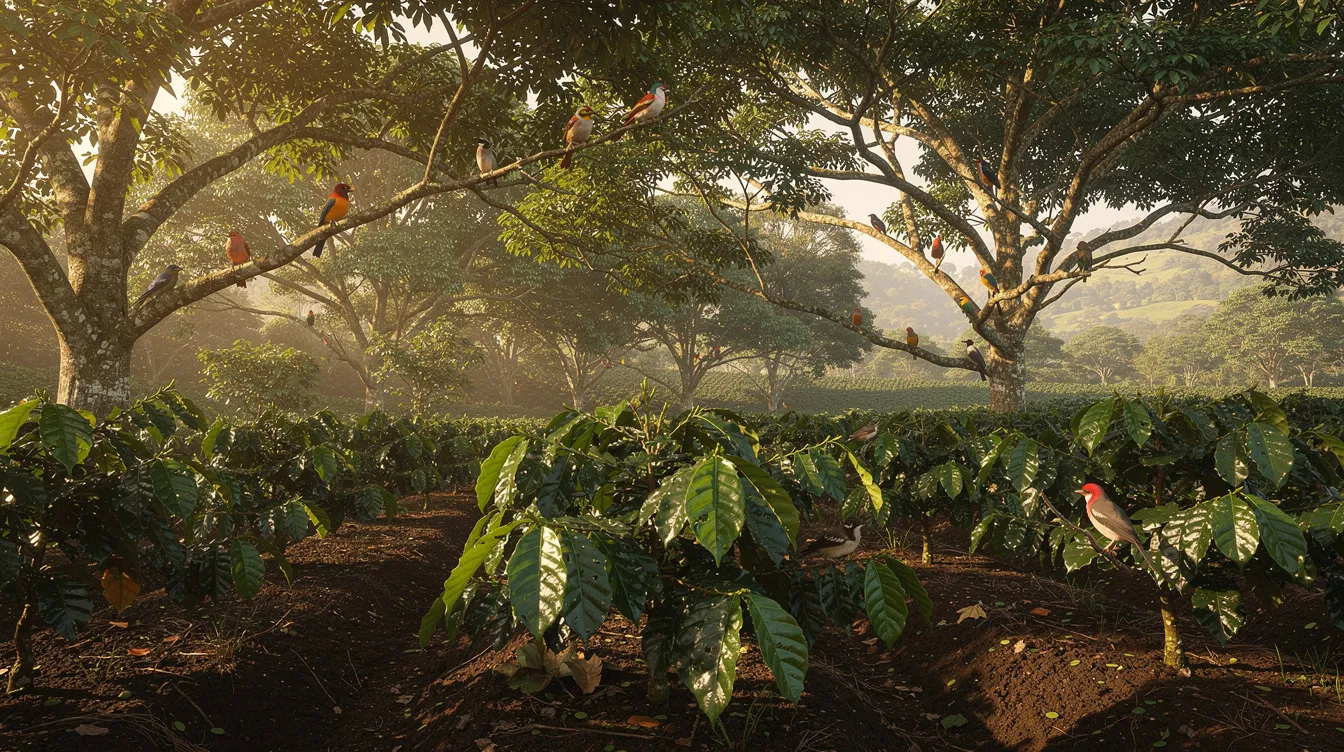
Bird-Friendly Coffee certification promotes bird conservation through sustainable practices and promotes biodiversity and protects natural resources. The bird friendly coffee label requires 100% product purity and traceability; farms are recertified every three years.
Shade-grown coffee refers to coffee grown under a canopy of trees, supporting biodiversity and soil health. But “shade grown” alone is not a regulated term. A farm with 5% shade cover could use the phrase without certification. The ecological benefits of genuine shade grown coffee include bird corridors, pollinator habitat, cooler microclimates, and climate resilience. Buyers seeking maximum habitat impact should look for the Bird Friendly logo from the Smithsonian Migratory Bird Center rather than relying on unverified “shade grown” language.
Direct Trade, Relationship Coffee & Traceability
Direct Trade emphasizes relationships between producers and roasters, typically with above-market prices tied to quality. Direct Trade Certified coffee often comes from small-scale farmers, and roasters pay premium prices for Direct Trade Certified coffee to maintain direct relationships and incentivize quality improvements.
Direct Trade does not have specific certification standards. There is no universal auditing body; standards vary by roaster. Direct Trade encourages transparency and sustainability in sourcing, but credibility depends on published details: farm name, harvest year, variety, cupping score, FOB price, and visit frequency.
Many Direct Trade coffees follow strong organic practices or meet Fair Trade-style pricing but skip formal seals due to certification costs. Buyers should evaluate concrete disclosures rather than the phrase “Direct Trade” alone.
Specialty Coffee Grading & Quality Certifications
Specialty coffee refers primarily to quality scoring and characteristics rather than sustainability certification. It describes Arabica coffees scoring 80 or above on SCA-style cupping scales, assessed by licensed Q graders. A 350-gram sample must have zero primary defects and no more than five secondary defects.
Scoring bands: 80-84.99 (very good), 85-89.99 (excellent), 90-100 (outstanding, rare). About 3-5% of global coffee meets specialty grade.
Labels like “Cup of Excellence finalist” or “micro-lot with 86+ score” signal quality and traceability but are distinct from sustainability certifications. A coffee can be specialty grade without being organic or Fair Trade, and vice versa. Capitol City Coffee treats quality-related labels as one input alongside ethical certifications when curating recommendations.
How to Read Certified Coffee Labels vs. Marketing Claims
Modern coffee bags carry a mix of regulated seals and unverified buzzwords. Here is how to tell them apart:
- Look for official logos: USDA Organic, Fairtrade, Rainforest Alliance (frog), Bird Friendly (Smithsonian). These seals require compliance and auditing. A certified B Corporation evaluates a company’s social and environmental performance and may appear on roaster packaging, though it certifies the company, not the coffee itself.
- Spot unregulated terms: Words like “ethical,” “sustainable,” “farm-to-cup,” and generic “shade grown” usually lack clear third-party certification requirements. They may reflect real practices or they may not.
- Check for traceability data: Origin country and region, farm or co-op name, harvest year, processing method, roast date. These details signal transparency and care from producers and roasters.
- Understand U.S. organic labeling rules: “100% Organic” means all content is organic. “Organic” means at least 95%. “Made with Organic” means 70-95%, and the USDA Organic seal cannot appear on this tier.
- Question vague claims: “Supports farmers” without disclosed price premiums, program partners, or certification numbers deserves skepticism. Companies making sustainability claims in marketing materials should back them with checkable data.
How to Choose Certified Coffee That Matches Your Priorities
There is no single “best” certification. The right choice depends on whether you prioritize environment, farmer income, flavor, or budget.
- Environment and chemicals first: Look for USDA Organic and Bird Friendly. These promote sustainable farming practices with strict rules on inputs and habitat.
- Farmer income first: Fair Trade sets price floors and community premiums. Fairtrade International and Fair Trade USA certifications channel money back to cooperatives.
- Flavor first: Start with specialty-grade, traceable single origins (named farms, cupping scores, harvest years), then add certifications as a filter. Some top microlots skip seals due to cost.
- Budget considerations: Certified coffees cost more per pound at retail, but home brewing typically runs $0.25-$0.75 per cup versus $4-$6 at a cafe. The per-cup premium for certified beans at home is often under $0.10.
- Freshness matters: Buy whole-bean with a printed roast date. Lighter roasts suit pour-over and filter; medium-dark works for espresso and drip machines.
- Experiment: Try one certified organic Fair Trade coffee, one Rainforest Alliance blend, and one Direct Trade specialty lot. Compare flavor, cost, and whether the sourcing story aligns with your values.
Common Misconceptions About Certified Coffee
Buzzwords around certified coffee create oversimplified assumptions. Here are five common myths.
“Certified coffee always tastes better.” Taste depends on origin, processing, freshness, and roast. Certification verifies farming or trade practices, not flavor. Sustainable practices can correlate with quality focus, but bland certified coffees and exceptional non-certified lots both exist.
“Fair Trade guarantees high wages for every worker.” Fair Trade sets a minimum price to cooperatives and funds community projects. Individual worker pay depends on local context, enforcement, and farm structure. Fair Trade addresses fair prices at the cooperative level, not every link in the chain.
“Organic coffee is completely pesticide-free.” Organic prohibits most synthetic agrochemicals but permits approved natural inputs. Drift from neighboring farms is possible. The benefit lies in avoiding synthetic pesticides, synthetic fertilizers, and promoting soil health and biodiversity.
“Direct Trade is always more ethical than certifications.” It can be, when roasters publish prices, visit farms, and maintain long-term partnerships. Without third-party standards, impact varies widely. Certifications add accountability through audits; Direct Trade adds accountability through transparency, when the roaster provides it.
“If a bag lacks certification, it must be unsustainable.” Many small farms follow strong environmental and social practices but skip certification due to fees and paperwork. Look for detailed sourcing info: farm name, region, harvest year, processing method. Knowledge of the roaster’s sourcing philosophy matters more than seal count.
How Capitol City Coffee Researches & Curates Recommendations
Capitol City Coffee is an independent coffee editorial and affiliate publication. It does not roast, sell, or claim hands-on tasting unless documented testing notes are supplied. When recommending certified coffee brands or gear, CCC relies on researched editorial analysis: published certification data, roaster transparency reports, expert commentary, and aggregated third-party consensus.
CCC reviews whether roasters provide traceability (farm names, regions, harvest years), disclose partnerships with programs like Fairtrade, Rainforest Alliance, or Bird Friendly, and explain their Direct Trade criteria. Affiliate relationships never determine rankings. Recommendations consider flavor profiles as described by roasters and cupping reports, roast levels, brew-method fit, value, and availability to U.S. buyers and consumers.
For coffee equipment (such as SCA Certified brewers), CCC references measurable performance, third-party testing, durability reports, and ease of cleaning rather than personal long-term use. Any commercial links are disclosed near the first recommendation. The goal is to simplify certified coffee choices while remaining transparent about editorial methods.
FAQs About Certified Coffee & Sourcing
These questions address topics not fully covered in the main sections above.
Is decaf coffee available with the same certifications (Organic, Fair Trade, Rainforest Alliance, Bird Friendly)?
Many decaf coffees carry certified organic and Fair Trade seals, and some are Rainforest Alliance or Bird Friendly certified. Selection is narrower than for regular coffee. The decaffeination process (Swiss Water, CO2, etc.) is separate from farming certifications; buyers should confirm both the desired decaf method and the relevant seal on the bag. Specialty roasters online often stock certified decaf options that supermarket shelves do not.
Can espresso beans be certified, or are certifications only for filter coffee?
Certifications apply to green coffee at the farm and supply chain level, regardless of roast profile or brew method. Espresso blends can be organic, Fair Trade, Rainforest Alliance, or Bird Friendly. “Espresso” on a bag describes roast and grind intent, not a different crop. Certified espresso blends are common among specialty roasters. Choose a roast level that suits your espresso preparation (typically medium to dark) and check for a roast date.
Is it better to buy coffee with multiple certifications or focus on one label?
Multi-certified coffees (e.g., Organic + Fair Trade + Bird Friendly) signal strong overall practices but are rarer and more expensive due to combined compliance costs. Most buyers do well starting with one or two priorities: organic for chemical concerns, Fair Trade for fair wages and community investment, Bird Friendly for habitat. Beyond a certain point, more seals do not automatically mean proportionally more impact. Clarity of personal goals is more useful than chasing the longest list of logos.
How can offices or shared spaces switch to certified coffee without doubling their budget?
Start with one step: switch the main bulk brew to a certified organic or Fair Trade blend, and keep specialty micro-lots as occasional features. Buying in larger bags (2-5 lb) or through wholesale and subscription channels reduces per-pound costs. Communicate the change with signage explaining what the certification means; a modest per-cup cost increase (often a few cents) is easier for teams to support when the reasoning is visible.
Where can I learn more about coffee types, origins, and certifications?
The broader learning hub at /learn/ covers brewing methods, flavor basics, and related topics. A guide to coffee origins and terroir at /coffee/origins/ explores how growing coffee in different regions produces distinct cup profiles. For a reference on styles and roast approaches, see /coffee/types/. Bookmark this page at /learn/certifications/ and revisit it when comparing labels on your next purchase.