When you’re deciding between a Moccamaster and an OXO 9-Cup, the answer is straightforward: choose the Moccamaster if you care most about coffee quality, long-term durability, and a simpler brew ritual; choose the OXO if you want excellent SCA-certified drip coffee with more programmable convenience at a lower price. Both machines can make very good coffee, but they differ in build philosophy, workflow, and what kind of owner they suit.
If you’re a coffee enthusiast trying to get café-level drip coffee at home and weighing simplicity against modern features, this comparison is built to help you decide. It looks at the specs, brewing performance, build quality, day-to-day use, programmability, durability, price, and the situations where each brewer makes more sense, because the machine you pick will shape your daily routine, your coffee quality, and how well your investment holds up over time.
This is a researched editorial analysis based on verified specs, expert consensus, and third-party reviews – not hands-on testing.
Best premium drip pick
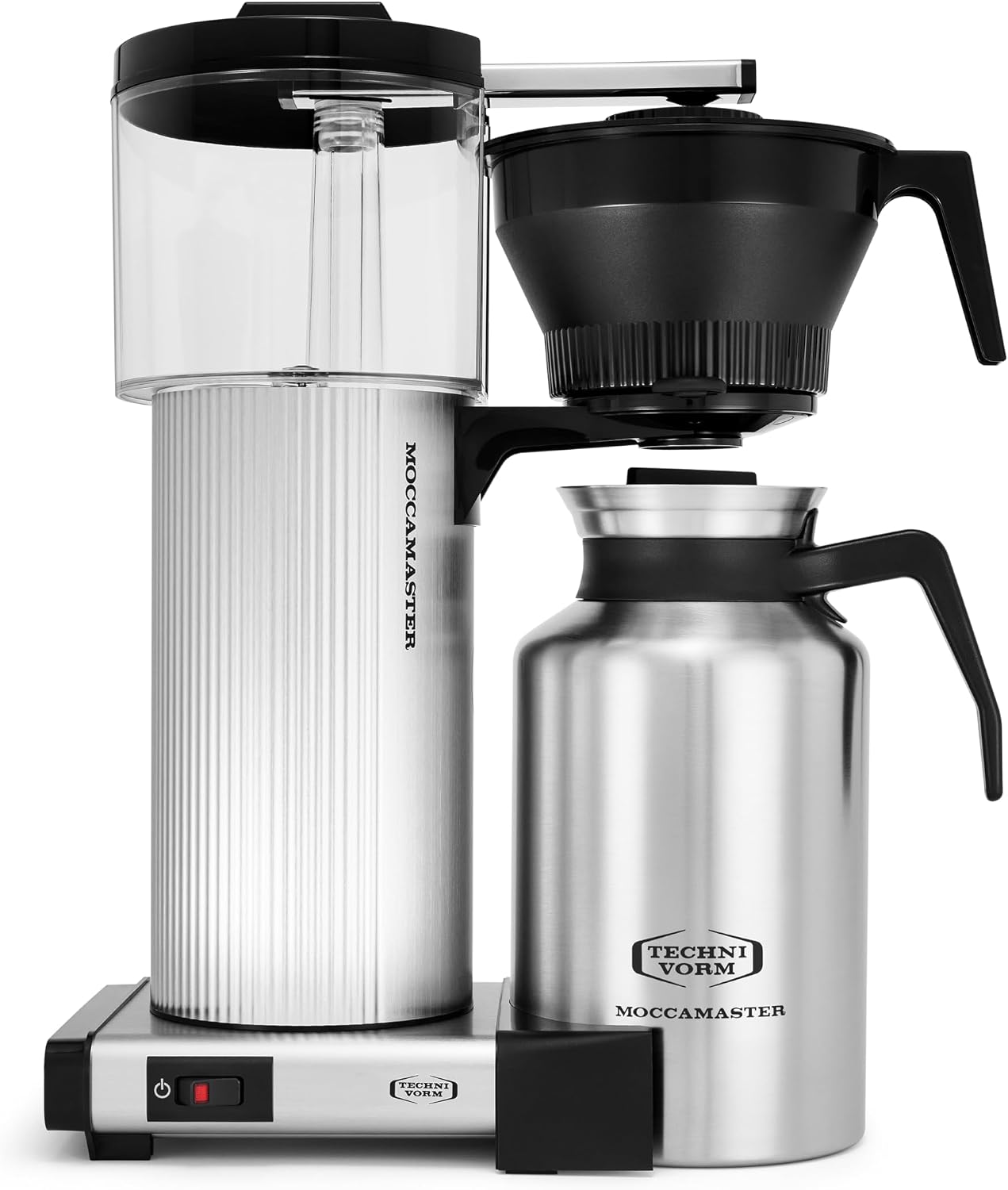
For this roundup, Moccamaster KBGV is the premium drip we recommend first—the same pick at the top of our At-a-glance cards below.
The Moccamaster is known for producing a cleaner and brighter cup of coffee, with a faster brew time (about 4–6 minutes for a full pot) and a 5-year warranty backed by lifetime repairs through modular parts. It typically costs $350–$370.
The OXO Brew 9-Cup offers a smoother and more balanced cup of coffee, a programmable auto brew feature with a wake-up timer, and a double-wall thermal carafe – all for roughly $220–$250.
Both machines are SCA-certified for meeting home-brewing standards and produce consistently high-quality coffee when used with quality beans. The deciding factor is workflow preference, not a flavor catastrophe on either side.
Moccamaster prioritizes longevity and simplicity in design, while OXO models include modern features and convenience. Budget, counter space, and how you feel about flipping a switch versus setting a timer should guide your decision.
Affiliate disclosure
Capitol City Coffee may earn a commission from qualifying purchases made through links in this article, at no extra cost to you. Commissions do not influence our rankings or recommendations.
Quick verdict: Moccamaster vs OXO 9-Cup
Choose a Technivorm Moccamaster (KBT or KBGT) if you want the best-tasting drip coffee from an automatic machine and plan to keep it for a decade or more. Its copper heating element delivers remarkably stable brew temperature, and Moccamaster coffee is rated best tasting by testing panels across multiple expert roundups. Choose the OXO Brew 9-Cup if you want an SCA-certified drip brewer with a programmable timer, auto brew function, and a lower upfront cost – and you’re willing to accept a shorter warranty and slightly longer brew cycle.
The core trade-off: Moccamaster wins on extraction consistency, brew speed, and build quality; OXO wins on convenient features and price. Both prioritize different brewing philosophies but land in the same quality tier for the resulting coffee.
If you’re still unsure, keep reading for a detailed breakdown of performance, usability, cost, and which machine fits specific lifestyles.
Disclosure: This page contains affiliate links. As an Amazon Associate I earn from qualifying purchases.
Here’s a quick side-by-side overview of the two coffee makers. Both are SCA-certified automatic drip coffee makers, and the SCA standards cover brew temperature, brew time, and extraction consistency.
Both the Moccamaster and OXO 9-Cup are automatic drip coffee makers. They’re not espresso machines, pod brewers, or cold brew makers. They heat hot water to a precise temperature, pass it through ground coffee in a filter basket, and collect the resulting coffee in a carafe. That’s the entire brewing process – and when it’s done well, it produces great coffee without manual pour-over effort.
They’re designed for people who buy decent coffee beans and want café-level drip coffee every morning without fussing over kettle temperatures or pour rates. If you’re weighing whether a pod system might suit you better, a comparison of Nespresso and Keurig covers that territory.
Both machines work best paired with quality coffee grinders and fresh whole beans ground to a medium consistency. Pre-ground coffee will still produce a good cup, but you’ll notice a difference in flavor clarity and aroma if you grind fresh.
Technivorm Moccamaster overview
Technivorm has been hand-assembling Moccamaster brewers in the Netherlands since 1968. The brand has built a reputation as a benchmark drip brewer for durability, temperature consistency, and straightforward design. There’s no touchscreen, no app, and no Bluetooth – just a copper heating element and a switch.
For this comparison, the focus is on the Moccamaster KBT and KBGT thermal carafe models, though findings apply broadly to similar Moccamaster drip models. Moccamaster has 12 models certified by the Golden Cup Standard, which speaks to the brand’s consistent engineering across its lineup. The Speciality Coffee Association certification on these models confirms they meet strict standards for brew temperature, brew time, and extraction.
Moccamaster emphasizes longevity and simplicity in design. The machines are built with metal housings, copper boilers, and modular parts that can be replaced individually – a philosophy closer to commercial equipment than consumer appliances.
OXO Brew 9-Cup overview
OXO is a US-based kitchenware brand known for ergonomic, user-friendly designs across everything from spatulas to digital scales. The OXO Brew 9-Cup is their flagship SCA-certified drip coffee maker, positioned as a compact machine that pairs good coffee with modern programmable features.
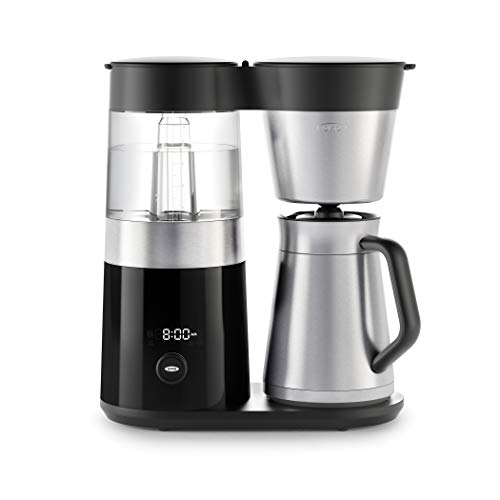
OXO’s 9-cup coffee maker is SCAA Golden Cup certified and uses BetterBrew Precision technology for optimal extraction – their term for the temperature control and water distribution system that keeps the brew cycle within SCA parameters. It’s a fully programmable coffee machine with a 24-hour wake-up timer, dial-based controls, and a double-wall insulated carafe. It also uses a removable water tank for easier filling and upkeep.
The OXO 9-Cup is often recommended as a good drip coffee maker for people upgrading from a basic 12 cup programmable brewer. It targets the space between budget machines and premium options like the Moccamaster, offering more features per dollar than most SCA-certified competitors.
Performance comparison: brew temperature, brew time, and flavor
This section compares the brewing fundamentals that most directly affect what ends up in your cup of coffee: brew temperature, brew time, and how evenly coffee grounds get soaked during the brew cycle.
The ideal water temperature for brewing coffee ranges from 196°F to 205°F – the window where water and coffee temperature support proper extraction, sweetness, and complexity without pulling harsh bitterness. Both brewers aim to hold water temperature within this range throughout the entire brew cycle, but they get there differently.
The Moccamaster KBT brews coffee at 196°F to 205°F. Its copper heating element heats water rapidly in about five minutes, and the machine can complete a full pot of coffee in about 4–6 minutes. That speed isn’t a shortcut – it’s a function of the powerful heating element maintaining optimal brewing temperatures throughout extraction. Moccamaster uses a 9-hole water outlet arm (often called a spray head) to distribute hot water across the coffee grounds, ensuring the bed is evenly soaked. In taste tests and expert panels, Moccamaster coffee is consistently rated best tasting, particularly with lighter roasts where brightness and nuance matter most. Moccamaster is known for producing a cleaner and brighter cup of coffee.
The OXO 9-Cup maintains an average brew temperature between 197.6°F and 204.8°F, squarely within SCA spec, and is designed to maintain optimal brewing temperatures through the full cycle. However, its brew time runs longer – roughly 8–10 minutes for a full pot based on multiple expert reviews. The OXO 9-cup uses a 7-hole Rainmaker showerhead for even water dispersion across the grounds, and the OXO 9-cup features BetterBrew Precision technology for optimal brewing, which includes micro-pauses to let grounds bloom before full extraction. OXO offers a smoother and more balanced cup of coffee – delicious coffee, certainly, but some coffee professionals find it slightly less complex than what the Moccamaster produces.
Both machines produce consistently high-quality coffee when used with quality beans. The difference is subtle enough that dark-roast drinkers may not notice it, but specialty coffee lovers working with single-origin light roasts will likely prefer the Moccamaster’s faster, more energetic extraction.
Capacity, carafe, and heat retention
The Moccamaster KBT holds approximately 40 ounces (about 10 “cups” by manufacturer labeling – worth noting that a coffee maker “cup” is typically 5 ounces, not a standard mug). The OXO Brew 9-Cup holds roughly 9 of these smaller cups. For context, a common 12 cup home coffee maker typically holds about 60 ounces, so both machines here are slightly smaller than the standard. Either will comfortably serve 2–4 people or give one serious coffee drinker a generous morning supply.
The Moccamaster KBT uses a glass-lined stainless steel carafe for thermal retention. Other Moccamaster models use a glass carafe paired with a hot plate, which keeps coffee warm but risks overcooking flavor if the pot sits too long – a hot plate auto-shutoff kicks in after about 100 minutes on some models, but by then the coffee has already degraded. The thermal models avoid this entirely. One note: Moccamaster’s water reservoir is not removable for easy filling, while the OXO has a removable water reservoir, which means you carry water to the machine or position it near a faucet with the Moccamaster.
The OXO 9-Cup uses a double-wall stainless steel carafe (effectively an insulated carafe) that keeps coffee hot without any hot plate. This generally preserves flavor better over an hour or two. OXO’s carafe features a comfortable ergonomic handle, which is a small but appreciated detail for daily use. However, the OXO’s narrower carafe mouth is a recurring complaint in reviews – cleaning can be more difficult, and trapped residue may affect flavor over time if not addressed.
For brewing a half pot, the OXO has cup-count settings that adjust the brew cycle timing, while some Moccamaster models include a half/full carafe selector and a manual drip stopper. Neither machine excels at very small batches (1–2 mugs), where a pour-over or French press will outperform both.
Workflow and usability: how each coffee maker feels to use
Day-to-day, the Moccamaster’s workflow is almost comically simple. Fill the water reservoir, add a coffee filter and coffee grounds to the brew basket, and flip the switch. That’s it. Moccamaster has a simple on-off switch for operation – no menus, no programming, no learning curve. Some models include a manual drip stopper, so you can pull the carafe mid-brew without dripping, though others require you to be more careful with timing.
The OXO 9-Cup involves a bit more interaction. Its digital interface uses a single dial to select cup count, set the programmable timer, and initiate brewing. The OXO Brew allows for programmable brewing with features like a wake-up timer, so you can load grounds the night before and have fresh coffee ready when your alarm goes off. The OXO 9-Cup has a programmable timer for auto-brew, and it automatically pauses the flow when the carafe is removed mid-brew.
According to third-party reviews, the OXO’s interface has a few quirks – the dial and display take a session or two to learn, and programming the timer isn’t as intuitive as a simple clock. But once set, the auto brew feature works reliably. Coffee lovers who want their morning cup waiting for them will appreciate this. Those who find digital interfaces annoying will gravitate toward the Moccamaster’s analog simplicity.
Convenient features and programmability
This is where the OXO 9-Cup clearly differentiates itself. OXO models include modern features and convenience that the Moccamaster simply doesn’t offer.
The OXO’s feature list includes: a 24-hour programmable auto brew function (set it the night before and wake up to coffee ready), automatic pre-infusion that blooms grounds before full extraction, pause-and-pour for grabbing a cup mid-cycle, a freshness indicator that tracks how long your pot has been sitting, and descaling reminders. The OXO’s 9-cup model is fully programmable in a way that feels designed around busy weekday mornings.
Moccamaster generally forgoes programmability. There’s no clock, no auto brew, no smartphone integration – nothing beyond the physical switch and, on some models, a half-carafe selector. This is deliberate: fewer electronics means fewer failure points. But it also means you can’t schedule a brew. You must be present to start the machine.
How important are these features in practice? If you share a kitchen with other people who brew at different times, or if you genuinely need coffee within seconds of waking, the OXO’s timer is a meaningful convenience. If you’re the type who enjoys the brief ritual of setting up a fresh brew each morning, the Moccamaster’s simplicity is a feature, not a limitation.
Footprint, design, and build quality
The Moccamaster KBT measures approximately 15.25″ high × 11.50″ wide × 6.75″ deep and weighs about 6 pounds. It’s wider than the OXO but shorter, which matters if you have low kitchen cabinets. The design is distinctive – an exposed copper heating element, visible water reservoir, and retro-industrial aesthetic available in over 20 colors. It looks like coffee equipment, not a kitchen appliance.
The OXO 9-Cup is taller (about 17.5″ high) but narrower (8.2″ wide × 10.5″ deep), making it a more compact machine in terms of counter footprint – though height clearance under cabinets may be tight. Its look is modern and minimalist, with a matte black or stainless finish that blends into contemporary kitchens.
Build quality is where these machines diverge most noticeably. The Moccamaster uses metal housing, a copper boiler, and replaceable modular components. It feels solid and industrial. The OXO’s body is more plastic-heavy, with an integrated construction that’s sleeker but less repair-friendly. Third-party feedback consistently describes the Moccamaster as feeling built to outlast its owner, while the OXO feels like a well-made but ultimately consumer-grade appliance.
Cleaning and maintenance
Cleaning affects both flavor and how often you actually want to use your coffee machine. Residual oils and mineral buildup from hard water will eventually degrade any drip brewer’s output.
For routine cleaning, the Moccamaster is straightforward. The brew basket lifts out easily, the thermal carafe has a relatively wide opening, and there are few crevices where old coffee grounds or oils can hide. Glass carafe models with a hot plate need occasional cleaning of the warming surface as well.
The OXO 9-Cup’s main cleaning challenge is the thermal carafe. Its narrower opening makes scrubbing the interior more difficult, and some users report trapped residue building up over months. The brew basket area is reasonably accessible, but the more complex internal plumbing (mixing tube, pre-infusion pathways) means there’s more surface area that could accumulate mineral deposits.
Both machines need regular descaling – roughly every 1–3 months depending on water hardness. The OXO includes a descaling reminder, which is a helpful nudge. The Moccamaster relies on user diligence, though Technivorm provides clear descaling instructions. Using filtered water extends the interval for both.
Durability, warranty, and support
Moccamaster has a 5-year warranty and lifetime repairs. That’s not marketing language – Technivorm genuinely supports repairs on machines well past their warranty period through modular parts. Moccamaster’s warranty covers all parts and repairs, excluding carafes and items designed to be replaced. Moccamaster machines are designed for longevity and easy repairs, and replacement parts remain available for all models, including older ones. Many owners report 10+ years of daily use.
Moccamaster has a 5-year warranty compared to OXO’s standard 2-year warranty. OXO provides a 2-year warranty on its coffee makers, and OXO is known for excellent customer service and responsiveness during that period. However, OXO machines perform exceptionally well but are generally replaced as a whole unit if major components fail. Post-warranty, the repair path is less clear – spare parts availability is limited, and the integrated design makes DIY repair difficult.
Moccamaster’s repairs are facilitated through modular parts, meaning a failed switch, heating element, or gasket can be swapped individually. This repair-friendly philosophy is increasingly rare in consumer appliances and is a genuine differentiator for coffee drinkers who plan to use their machine daily for years.
Cost and value for money
Current typical US prices: the Moccamaster KBT/KBGT runs about $350–$370. The OXO Brew 9-Cup typically sells for $220–$250, with occasional deals dipping below $225. That’s roughly a $120–$150 gap.
Value, though, isn’t just sticker price. If a Moccamaster lasts 10 years (conservative for this machine), the daily cost is about $0.10. An OXO lasting 5 years at $235 costs about $0.13 per day – and if it needs replacing sooner, the total cost of ownership rises. Factor in the Moccamaster’s longer warranty and repair access, and the initial price premium starts to shrink.
On the other hand, the OXO delivers programmable features, a better thermal carafe design (no hot plate risk), and solid SCA-level performance for roughly 60% of the Moccamaster’s price. For coffee drinkers who upgrade machines every few years anyway – or who value convenient features over pure longevity – the OXO represents better value per feature dollar.
Neither is the cheapest drip coffee maker on the market. Budget-conscious buyers can find capable machines under $100, though few will match the brew temperature consistency or extraction quality of these SCA-certified options. On the other end, the Breville Precision Brewer offers more customization (bloom time, temperature control, even a cold brew mode) at a similar price to the Moccamaster, though with a different set of trade-offs.
Winner by use case
Rather than declaring one universal winner, here’s how each machine fits specific coffee drinkers.
For flavor-first coffee drinkers – specialty coffee enthusiasts who invest in single-origin beans and a quality burr grinder – the Moccamaster is the better fit. Its faster brew time and stable brew temperature extract more brightness and complexity, especially from lighter roasts. Coffee expert panels and taste tests consistently favor its output. If your beans cost $18+ per bag, the machine should do them justice.
For set-and-forget weekday brewers who want coffee ready the moment they walk into the kitchen, the OXO 9-Cup wins clearly. Its auto brew feature and programmable timer mean you load coffee grounds the night before and wake up to a fresh pot. No other drip coffee maker in this price range offers this combination of SCA-certified quality and scheduling convenience.
For households brewing multiple pots daily – families of coffee drinkers or home offices – the Moccamaster’s speed (a full pot in about six minutes) and commercial-grade durability make it more practical. You can cycle through multiple pots quickly without worrying about wear on components.
For small spaces and shared kitchens, the OXO’s narrower footprint gives it a slight edge, though its height may be an issue under low cabinets. Both machines are reasonable for apartment kitchens, but neither is truly “compact” compared to a pour-over dripper or single-serve system. In scenarios where either machine could work, personal preference for manual versus programmable workflow should be the tiebreaker.
Who should choose the Moccamaster?
The Moccamaster is best for people who prioritize coffee quality, longevity, and simple controls over advanced programmability. It’s a buy-it-for-life coffee machine for those who see a drip brewer as a long-term kitchen investment.
Ideal buyers include: specialty coffee enthusiasts who taste the difference between good and great extraction; people who already own (or plan to buy) high-end coffee beans and coffee grinders; households that go through multiple pots a day; and anyone concerned about plastic contact with hot water – Moccamaster offers metal and ceramic filter holder options.
Key benefits: fast brew time, stable brew temperature from that copper heating element, large capacity (40 oz), robust metal construction, a 5-year warranty with lifetime repair support, and access to replacement parts for every model. Moccamaster offers a 5-year warranty and lifetime repairs – a rare commitment.
Honest limitations: higher upfront price ($350+), no auto brew or clock, a slightly larger footprint, and manual brew basket control on some models that requires you to engage a drip stopper before pulling the carafe.
Who should choose the OXO Brew 9-Cup?
The OXO 9-Cup is the better choice for convenience-focused drinkers who still care about good coffee but don’t want to sacrifice modern workflow features.
Typical buyers include: busy professionals who want their morning cup of coffee waiting when they wake up; families upgrading from a basic 12 cup programmable coffee maker; anyone who values a modern, minimalist aesthetic; and people who don’t plan to keep a drip coffee maker for more than 4–5 years.
OXO’s strengths: solid SCA-level brew quality through BetterBrew Precision technology, a programmable start with a 24-hour wake-up timer, the 7-hole Rainmaker showerhead for even saturation, an intuitive (after the initial learning session) digital interface, a double-wall stainless steel carafe that keeps coffee warm without a hot plate, and a price point that’s roughly $120–$150 less than a Moccamaster.
Trade-offs: a shorter 2-year warranty, potentially less long-term durability, a narrower carafe opening that’s harder to clean, and flavor that – while certainly delicious coffee – may be a bit less nuanced than top-tier machines like the Moccamaster or the Breville Precision Brewer according to expert tastings.
How they compare to other drip coffee makers
In the wider landscape of coffee makers, the Moccamaster and OXO 9-Cup occupy a specific niche: SCA-certified machines that deliver excellent coffee without requiring manual pour-over technique. Most budget programmable 12 cup machines can’t match their brew temperature consistency. Most other drip coffee maker options at the $100–$150 range hit SCA parameters less reliably.
The Moccamaster competes most directly with other premium brewers focused on coffee quality and durability – machines like certain Bonavita models and the Breville Precision Brewer, which adds granular temperature control, bloom timing, and even a cold brew mode for those who want maximum customization. The OXO 9-Cup competes with feature-rich mid-to-upper-range models that balance good coffee with convenient features.
For readers weighing whether espresso or drip is the right path, an espresso machine versus coffee maker comparison covers the fundamental differences in brewing process, cost per cup, and workflow. This article focuses specifically on drip coffee makers.
Alternatives worth considering
If neither the Moccamaster nor the OXO 9-Cup is a perfect fit, a few alternatives might be better depending on budget or desired features.
For more customization, the Breville Precision Brewer offers adjustable brew temperature, bloom time, flow rate, and even cold brew and pour-over modes – all for a price similar to the Moccamaster. It appeals to people who want to tinker with every variable in the coffee brewing process.
For a tighter budget, other SCA-certified drip coffee makers from brands like Bonavita offer solid performance in the $120–$180 range, though with fewer features and less polished build quality. For the simplest possible setup, a reliable 12 cup programmable drip coffee maker from a trusted brand will get the job done for $50–$80, though brew temperature and extraction consistency will be less precise.
For maximum control without electronics, manual methods like pour-over (Hario V60, Kalita Wave) or a French press let you dictate every variable. Cold brew is a separate method and equipment category – not a replacement for these hot-brew machines, but a complementary option for iced coffee lovers who can use the same coffee beans.
Coffee beans and grind recommendations
Both machines reward fresh, high-quality coffee beans and an appropriate grind size from a burr grinder. The grinder often matters more than the machine itself for flavor improvement – a $300 brewer with stale pre-ground coffee will underperform a $150 brewer with freshly ground beans.
For roast level, light to medium roasts highlight the nuance and origin character that these SCA-certified brewers are designed to extract. Medium-dark roasts produce a more classic, fuller-bodied drip flavor. Aim for beans roasted within the last 2–4 weeks for the best coffee experience. Single-origin beans showcase each machine’s extraction clarity; blends tend to be more forgiving.
Grind size should be medium – roughly the texture of coarse sand. Too fine, and water passes too slowly, leading to over-extracted, bitter coffee. Too coarse, and water flows through too quickly, producing weak, sour results. A consistent grind from a quality burr grinder improves extraction consistency dramatically, which is why many coffee professionals consider the grinder as important an investment as the coffee maker.
Beans selected for these drip brewers often also work well for French press or pour-over if you use other coffee brewing methods at home.
Brew basket, filters, and small but important details
The Moccamaster uses a cone-style brew basket. On models like the KBT, a manual drip stopper lets you halt flow before removing the carafe, preventing drips. The basket sits securely and is easy to remove for cleaning. Some Moccamaster models accept both #4 paper filters and reusable metal filters.
The OXO 9-Cup has an automatic flow-control system – it detects when the carafe is removed and pauses the brew. The filter basket uses standard flat-bottom or cone filters depending on the model. OXO’s system aims to ensure coffee grounds stay evenly soaked throughout the brew cycle via its shower head water distribution.
For filters, bleached or high-quality paper filters typically yield the cleanest flavor and easiest cleanup in both brewers. Reusable metal filters allow more oils through (richer body but more sediment) and require regular scrubbing to prevent buildup.
Practical quirks to know: some reviewers note that the OXO’s brew basket can shift slightly on certain countertops, and the carafe detection mechanism occasionally needs a firm seat to engage. The Moccamaster’s manual drip stopper requires remembering to close it before pulling the carafe – forget, and you’ll have a puddle. These are minor issues, but the kind of details that shape daily coffee brewing satisfaction.
Safety, materials, and plastic contact concerns
Both brands state they use food-safe, BPA-free plastics in areas that contact hot water. This is standard for SCA-certified machines, and neither has been flagged by third-party safety reviews for material concerns.
The Moccamaster uses metal and high-quality plastics, with the copper heating element and metal housing keeping most critical hot water pathways in non-plastic materials. For those highly sensitive to plastic contact, aftermarket ceramic or stainless steel filter holders are available for some Moccamaster models.
The OXO’s design also routes very hot water through tested components, but its more integrated build offers fewer aftermarket swap options. The plastic content is higher in the water path compared to the Moccamaster.
If plastic contact is a significant concern for you, manual brew methods using glass, ceramic, or metal – like a Chemex or stainless steel French press – eliminate the issue entirely. For most users, both machines fall well within acceptable safety standards.
Which should you choose? (practical decision guide)
The Moccamaster vs OXO choice reduces to a single question: do you want a coffee machine that makes better coffee and lasts longer, or one that costs less and does more for you automatically?
Here’s a quick decision checklist:
Your budget ceiling is under $260 → OXO 9-Cup
You want coffee ready before you’re out of bed → OXO 9-Cup (auto brew feature)
You buy specialty-grade coffee beans and want every drop to count → Moccamaster
You plan to keep this machine for 7+ years → Moccamaster
You brew multiple pots daily → Moccamaster (faster brew time)
You prefer clean, minimal interfaces → Moccamaster
You want a compact machine for a small counter → Slight edge to OXO (narrower footprint)
Consider warranty, repairability, and the cost of your coffee beans and grinder alongside the machine price. A $350 machine paired with a $30 blade grinder and stale pre-ground coffee is a worse coffee experience than a $230 machine paired with a $100 burr grinder and fresh beans. Allocate your total budget wisely.
Most flavor-first buyers leaning toward premium gear will be happier with the Moccamaster. Convenience-driven buyers who still want good coffee – and don’t mind replacing a machine in 4–5 years – may prefer the OXO 9-Cup.
FAQ
These questions cover practical ownership issues not fully addressed above. Answers draw on manufacturer specs and expert consensus.
Can I brew just one or two cups in a Moccamaster or OXO 9-Cup without ruining the coffee?
Both machines can handle small batches, but performance varies. The OXO has a 2–4 cup mode that adjusts the brew cycle to maintain appropriate contact time and water temperature. The Moccamaster doesn’t have a dedicated small-batch mode, though the manual drip stopper and half pot selector on some models help. For very small single-cup brews, neither machine is ideal – the heating element and brew basket are designed for larger volumes. A pour-over dripper or AeroPress will produce a better single cup of coffee than either of these machines scaled down to minimum.
Do I need a separate coffee grinder, or will pre-ground coffee work?
Both machines will operate with pre-ground coffee, and you’ll still get a good cup from either. However, fresh grinding with a burr grinder significantly improves flavor and extraction consistency. A medium grind – roughly the texture of coarse sand – works best for these automatic drip coffee makers. If your coffee tastes sour, the grind is too coarse; if it tastes bitter and muddy, it’s too fine. Many coffee professionals and coffee expert reviewers consider the grinder as important an investment as the coffee machine itself. A $100 burr grinder paired with either of these machines will transform your coffee experience more than any other single upgrade.
How do these compare to an espresso machine or pod coffee maker?
Drip coffee makers like the Moccamaster and OXO 9-Cup are built for larger batches of brewed coffee – a full pot of coffee, not espresso-style shots or single-serve pods. The brewing process is fundamentally different: drip uses gravity and a lower pressure to extract from a larger bed of coarser coffee grounds over several minutes, while an espresso machine forces hot water through finely ground coffee at high pressure in 25–30 seconds. Cost per cup is generally lower with drip, and the flavor profile is lighter and more voluminous. If you primarily drink American-style drip or “regular coffee,” these brewers are a better match than capsule systems or espresso machines. For readers exploring that choice, comparing an espresso machine versus a coffee maker will clarify the differences.
Will either coffee maker work well with very dark roast or flavored coffee beans?
Both machines can brew dark roast and flavored coffee without any issues. However, extraction clarity and taste nuance – where these SCA-certified machines really shine – are more noticeable with high-quality single-origin or medium roasts. Very dark roasts may taste more bitter if brewed too hot or too long, so users may want to slightly coarsen their grind to compensate. Flavored coffee beans leave residual oils and aromas in the brew basket and carafe, so clean both more frequently if you switch between flavored and unflavored beans. This is especially important with the OXO’s narrower carafe opening, where lingering residue is harder to reach.
What happens if one of these coffee makers breaks after the warranty period?
This is where the two brands diverge significantly. Moccamaster offers a 5-year warranty and lifetime repairs through modular parts – even after warranty, you can order a replacement heating element, switch, or gasket and fix it yourself or through Technivorm’s service network. Many Moccamaster units are still brewing after 15+ years. The OXO provides a 2-year warranty on its coffee makers, and while OXO is known for excellent customer service during the warranty period, post-warranty repair options are limited. OXO machines perform exceptionally well but are generally replaced as a whole unit if major components fail. If you plan to keep your drip coffee maker for many years, Moccamaster’s repair infrastructure is one of its most compelling advantages – and a key reason coffee drinkers keep coffee fresh in these machines decade after decade.
How Capitol City Coffee Rates Coffee and Coffee Machines
Every coffee and coffee machine we recommend is scored on the same 100-point scale, so a recommendation on one page means the same thing as a recommendation on any other. Each pick is also labeled with how we reached its score.
Research-ratedScored from the roaster or manufacturer’s published specifications, independent results such as Coffee Review blind cuppings and SCA brewer certification, and patterns across verified buyer reviews. Most of our current picks are research-rated.
Hands-on testedThe Capitol City Coffee team has brewed the coffee or used the machine ourselves, following the testing steps below. We only use this label when that testing actually happened, and we show the date we tested.
Coffee beans: 100-point scale
What we score
Points
What we look at
Origin and sourcing transparency
20
Country, region, farm or cooperative, altitude, bean variety, and processing method are clearly disclosed.
Flavor evidence
25
Independent cupping scores, how closely the tasting notes match what the origin is known for, and our own cupping notes when hands-on tested.
Roast and freshness
15
Roast level stated, roast-date practices, whole-bean availability, and packaging with a one-way valve or resealable bag.
Brew versatility
15
How well the roast suits pour-over, drip, French press, cold brew, and espresso.
Value
15
Price per ounce compared with similar single-origin coffees or blends.
Buyer feedback
10
Volume and consistency of verified reviews, and recurring complaints about staleness, bitterness, or shipping.
Coffee machines and gear: 100-point scale
What we score
Points
What we look at
Brewing performance
25
Water temperature in the 195–205°F range, even extraction, and SCA certification or published test data.
Build quality and reliability
20
Materials, known failure points, and long-term owner reports.
Ease of use and cleaning
15
Setup, the daily routine, descaling, and dishwasher-safe parts.
Fit for your kitchen
10
Capacity, counter footprint, and noise.
Useful features
10
Programming, grind and temperature control, and carafe type. Features that improve the cup count more than extras that do not.
Value
10
Price compared with machines that perform similarly.
Warranty and support
10
Warranty length, parts availability, and how the brand handles repairs.
What the grades mean
Score
Grade
What it means
90–100
A
Exceptional. Our first recommendation for the feeling and setting described.
80–89
B
Strong. Excellent, with minor trade-offs we explain.
70–79
C
Good. Worth it for specific needs, with clear compromises.
Below 70
—
Not recommended. We do not feature these as picks.
How we test hands-on
When a pick carries the Hands-on tested label, this is the method behind it, and we note the date we tested.
Coffee: brewed fresh from whole beans following Specialty Coffee Association guidelines (water between 195 and 205°F, about 1 gram of coffee to every 15 to 18 grams of water) in the brew methods the roast suits best, such as pour-over, French press, or espresso. We taste it black first, then with milk if that is how most people drink it, and each taster scores it on their own before we compare notes.
Machines: used in our everyday routine rather than a single demo. We brew both full and small batches, check the brewing temperature and brew time, and run the cleaning or descaling steps the manual calls for.
How we choose the feeling and setting
We match each coffee to a mood and a moment based on its flavor profile and roast. Bright, citrusy light roasts suit energizing mornings. Chocolatey, full-bodied medium roasts suit slow or social moments. Richer roasts suit espresso and milk drinks. Each pick explains which facts led us to that match.
Our scores stay independent
Every score comes only from the criteria above. No brand can pay for a pick or a higher grade. We re-check ratings when a roast, listing, or model changes, and update or remove picks that no longer earn their grade.
Some links on this page are affiliate links. As an Amazon Associate, Capitol City Coffee earns from qualifying purchases, at no extra cost to you.
Questions about a rating? Reach the Capitol City Coffee team through our contact page.